



For most Microsoft partners, the Cloud Solution Provider program is now the main engine for cloud revenue. At the same time, public cloud spending is projected to reach $805 billion in 2024 and to double again by 2028. (IDC) That growth is good news, but it leaves distributors, direct bill partners, and MSPs drowning in manual work if their Microsoft CSP automation is weak.
Before you think about more sales staff, ask yourself:
- How much time does your team still spend on manual CSP billing, Azure usage reports, and invoice checks each month?
- How many days does it take to push a new subscription, license change, or NCE renewal from quote to cash?
- How often do you worry that a small error in your telecom or cloud billing system will quietly eat into margins?
As the partner business shifts toward high-touch services, partners now earn between $8.45 and $10.93 for every $1 of Microsoft revenue (Microsoft report). That upside is only realistic when CSP automation carries the weight of subscription lifecycle events, usage-based billing, and Partner Center data.
If you run CSP operations for a distributor, MSP, or indirect reseller, this guide will help you understand what CSP automation is, where manual processes hold you back, and how a platform like AppGallop can support Microsoft CSP billing automation, provisioning, and Partner Center integration without adding more headcount.
Key Takeaways
- Microsoft CSP automation connects Partner Center with billing, provisioning, and partner portals so you do not rely on spreadsheets and manual exports.
- Strong CSP automation covers quote-to-cash, usage-based billing, subscription lifecycle events, and reconciliation automation.
- Direct bill and indirect partners use CSP automation to manage multi-tenant SaaS, Azure consumption, and multi-currency billing at scale.
- Finance leaders care about revenue recognition automation, revenue leakage detection, and clear audit trails tied to CSP data.
- A platform like AppGallop adds cloud catalog management, service provisioning automation, and partner portal management in one place.
- Starting with a small step-by-step plan is better than replacing every system at once.
What Is Microsoft CSP Automation?
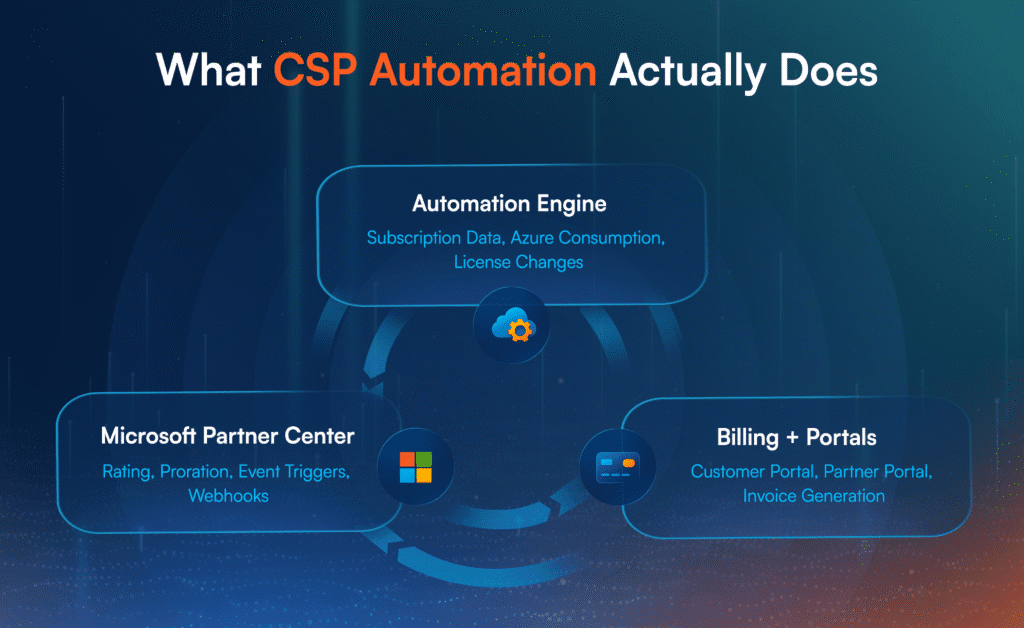
Microsoft CSP automation is the use of software and APIs to connect Partner Center with your own billing, provisioning, and partner systems. Instead of exporting CSV files and retyping data into a telecom billing system or ERP, CSP automation links these systems through API-first architecture, webhook notifications, and event-driven billing.
At a basic level, CSP automation should:
- Pull subscription, license, and Azure consumption data from Partner Center in near real time.
- Feed that data into a rating and charging engine for usage-based billing and proration billing.
- Push invoices into your accounting or ERP system and handle multi-currency billing and taxation.
- Trigger subscription lifecycle events such as upgrades, downgrades, NCE renewals, co-term alignment, and cancellations.
- Update customer and partner portals so tenants see the right services, prices, and renewal dates.
In more mature setups, CSP automation also powers cloud service brokerage, where you sell Microsoft services alongside ISV solutions, security bundles, UCaaS billing, and other subscription products through a single white-label marketplace.
Why Manual CSP Operations Hold Back Growth?
Manual CSP work often appears manageable at first: a few clients, basic Microsoft 365 licenses, and simple monthly invoices. The strain shows up when you add Azure, reserved capacity pricing, committed use discounts, or multi-entity accounting.
The cost of manual billing and reconciliation
Finance teams that rely on spreadsheets spend long hours matching usage data, discounts, and partner margins for each tenant. Studies show that automated invoice flows can cut processing costs by 60–80% (ResolvePay) and reduce AP processing costs by up to 80% (Clear).
When you apply the same logic to CSP billing, manual processes directly reduce profit per subscription.
Billing automation also reduces the impact of human error. One study notes that automation in billing flows can materially cut misbilling risk by limiting human touchpoints. For CSP partners handling thousands of subscriptions, even a small error rate turns into real revenue leakage.
Operational drag on sales and support
Without CSP automation, sales and support teams become part-time administrators:
- Sales staff create quotes manually and resend them each time Microsoft updates NCE offers or Partner Center pricing.
- Support agents handle service provisioning manually instead of using service provisioning automation to push orders to Azure and other clouds.
- Partner managers answer basic questions that a good partner portal management layer could solve with self-service.
This slows down lead-to-cash cycles and hurts renewal automation. It also limits partner onboarding velocity when you try to grow a two-tier distribution model or indirect sales channel.
Risk for finance and compliance
From a finance lens, manual CSP handling makes it hard to track revenue recognition automation, ASC 606 compliance, and IFRS 15 compliance. Data may live partly in Partner Center, partly in billing mediation layers, and partly in separate ERPs. That weakens audit trail maintenance and makes revenue leakage detection harder.
A strong CSP automation setup pulls usage, subscriptions, and payments into a single view so CFOs and finance directors can run Statement of Account checks per customer, track deferred revenue scheduling, and manage audit controls without extra spreadsheets.
Core Building Blocks Of A Strong CSP Automation Platform
A good Microsoft CSP automation platform is not just “a connector” for Partner Center. It should provide a full quote-to-cash path for cloud distribution and subscription businesses. Below is a view of the main building blocks and what they mean in practice.
CSP data and subscription lifecycle management
Subscription lifecycle events must move smoothly from Partner Center to billing and portals. That includes:
- New subscriptions, trials, and upgrades.
- Co-term alignment when you consolidate multiple licenses.
- True-up billing for usage that exceeds committed levels.
- Renewal automation and cancellation handling.
The platform should support Microsoft NCE, GDAP, and modern CSP rules without manual handling in each step.
Rating, charging, and revenue operations
CSP partners often use complex pricing:
- Usage-based billing for Azure, with tiered pricing models.
- Prorated charges for mid-cycle seat changes.
- Hybrid pricing models that mix fixed subscription fees with consumption overage charges.
Behind the scenes, a rating and charging engine and billing mediation layer should pull data from Partner Center, apply tariffs, and feed recurring revenue management. This is where multi-currency billing, VAT/GST management, and tax calculation come together.
From a finance point of view, the system also needs:
- Revenue recognition automation for ASC 606 and IFRS 15.
- Deferred billing and deferred revenue scheduling when customers pay ahead.
- Reconciliation automation and GL integration to ERPs such as SAP, NetSuite, or QuickBooks.
Provisioning and service orchestration
When a new order comes in, service provisioning automation should push it to Microsoft and other vendors with instant provisioning. That often relies on:
- API-first architecture with Partner Center, Azure, and ISV catalogs.
- Event-driven billing so provisioning events trigger charges.
- Tenant isolation for multi-tenant SaaS, so each customer’s data stays separate.
If you run bundled offerings with Microsoft services, telecom lines, and security software, service orchestration decomposes the bundle into service components, provisions each item, and tracks entitlements in one SKU management system.
Partner and channel management
For distributors and indirect providers, CSP automation must support partner lifecycle management and multi-tier distribution. Common needs include:
- Zero-touch model for onboarding new resellers with credit limits and dynamic credit management.
- Partner portal management where partners place orders, track renewals, and see margin data.
- Partner commission automation with sub-agent commissions for complex channel hierarchies.
- Channel margin management and partner discount schedules to keep profitability under control.
CSP partners that combine automation with strong partner programs benefit more from the marketplace opportunity, which is expected to reach $85 billion, with over half of that volume flowing through channels. (Source: Microsoft)
Analytics and business insight
Partner Center already offers subscription and license analytics, including churn and renewal trends. A CSP automation platform should add richer marketplace analytics, usage analytics, and partner performance scorecards so you can:
- Track customer LTV and expansion revenue.
- Watch usage analytics to spot upsell opportunities early.
- Monitor partner attach rate and partner ROI tracking across your ecosystem.
How CSP Automation Helps Different Partner Types?
Different partner types experience CSP automation in different ways, even if the same platform powers them.
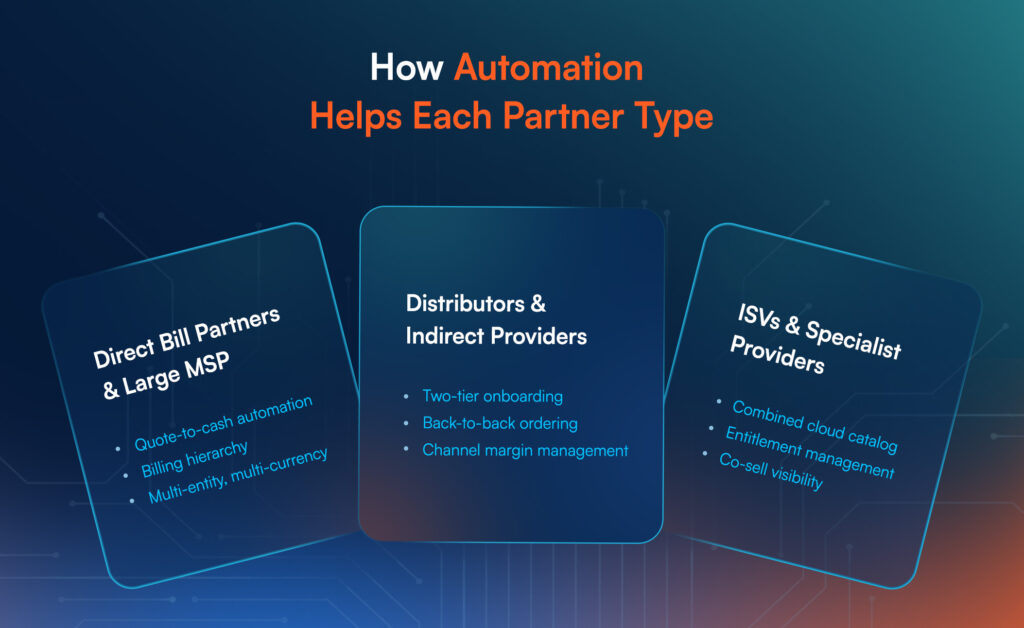
Direct bill partners and large MSPs
For direct bill partners and large MSPs, CSP automation provides the base for cloud distribution at scale. They rely on:
- Quote-to-cash flows that handle thousands of SKUs and complex contract management.
- Billing hierarchy management for parent-child account structures, often across regions.
- Multi-entity accounting and multi-currency billing for cross-border clients.
These partners care deeply about billing accuracy levels near 99.9 percent and solid support for ARPU growth.
Distributors and indirect providers
Distributors and indirect providers handle two-tier distribution models, master agent programs, and a wide network of resellers. CSP automation gives them:
- Partner ecosystem and distribution features like partner tier progression, partner engagement scoring, and channel program compliance tools.
- Back-to-back ordering support where you match orders from resellers to orders in Partner Center.
- Inventory-based and inventory-less scenarios when you combine CSP services with physical devices.
They also rely on marketplace listing optimization and private offer management to support co-selling motion with ISVs and telecom partners.
Specialist ISVs and solution providers
ISVs that list in the Microsoft commercial marketplace want CSP automation that makes their offers simple to sell alongside Microsoft services. For them, the main focus areas are:
- Cloud catalog management that combines Microsoft SKUs with their own SaaS offering.
- Entitlement management and licensing across direct customers and indirect resellers.
- Co-sell pipeline visibility and influenced deal tracking with CSPs and MSPs.
Designing A CSP Automation Roadmap
Moving from manual CSP operations to automation does not need a big bang change. A step-by-step plan works better and reduces risk.
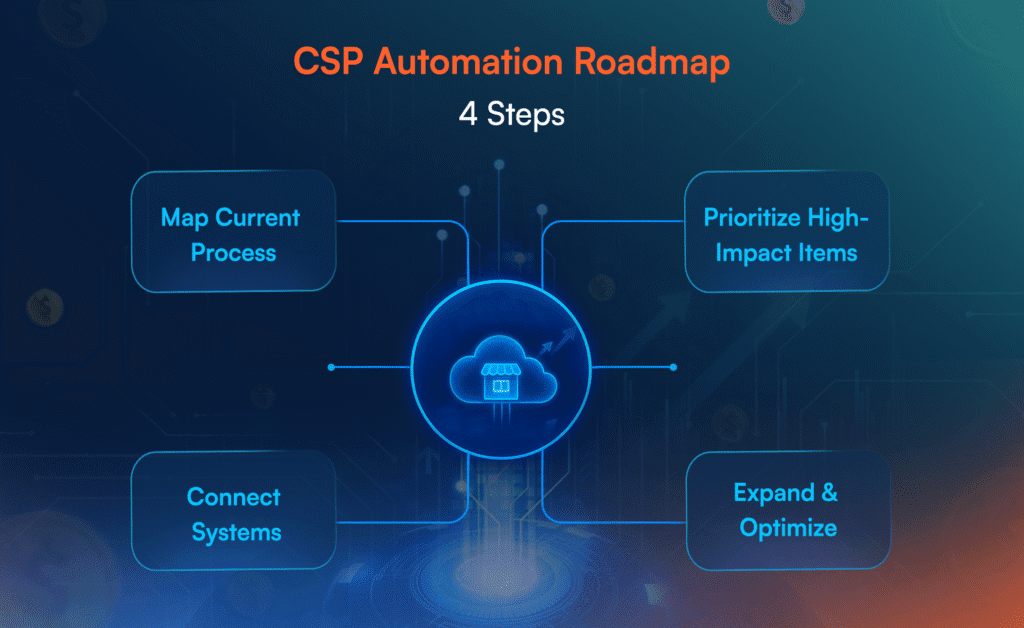
Step 1: Map your current quote-to-cash flow
Start by writing down how an order flows today, from lead management through quote journey, provisioning, billing, and collections workflow automation. Mark every place where someone exports data, edits a spreadsheet, or retypes information. Those steps are your first automation targets.
Step 2: Prioritize high-impact use cases
Typical early wins include:
- Automated Azure usage-based billing and consumption-based pricing.
- Subscription lifecycle events for NCE renewals and seat changes.
- Reconciliation automation between Partner Center data and ERP.
- Dunning campaign management for failed payments.
Remember that automated invoicing can cut processing time by up to 80% (Invoicer.ai). That alone often pays for the first phase of CSP automation.
Step 3: Connect Partner Center, billing, and marketplaces
Next, connect your CSP automation platform to Partner Center through APIs, then to your billing system and marketplace storefront. Use RBAC and SSO to keep access secure, and webhook notifications so changes in Partner Center trigger event-driven billing and provisioning.
Here you can introduce features like self-service procurement for partners and customers, and instant provisioning for common scenarios. This reduces order-to-delivery cycles from days to hours, which is a typical gain when telecom and CSP networks adopt automation.
Step 4: Expand to analytics, channel programs, and cross-vendor offers
Once the basics are in place, you can add marketplace analytics, partner performance scorecards, and product recommendation engines. This helps you support land and expand strategy, upsell security bundles, and manage cross-vendor offers across CSP, cybersecurity service billing, and backup-as-a-service billing.
How AppGallop Powers Microsoft CSP Automation Success?
AppGallop is built to handle Microsoft CSP automation for CSPs, MSPs, distributors, and telco partners that want full control of their cloud distribution business without writing custom code.
AppGallop connects directly with Microsoft Partner Center and provides:
- Native CSP, GDAP, and NCE support so subscription lifecycle events move cleanly from Partner Center into billing and partner portals.
- Microsoft CSP billing automation with usage-based billing, proration billing, and true-up billing for Azure consumption and SaaS licenses.
- Service provisioning automation for instant order-to-activation, including multi-cloud services and private offers.
- Partner portal management for indirect resellers, with custom pricing, credit control and management, and partner commission automation.
- Revenue and compliance controls through revenue recognition automation, audit trail maintenance, and tax handling for VAT/GST.
Direct bill CSPs and distributors using AppGallop typically replace several manual tools with a single platform, leading to faster quote-to-cash cycles and stronger revenue assurance.
Combined with AppGallop’s cloud marketplace capabilities, this gives Microsoft partners a solid base to grow Microsoft CSP revenue along with ISV and telecom offerings.
Stop Losing Hours To Manual CSP Billing And Azure Reconciliation. Schedule A Demo!
Conclusion
The CSP program will keep growing as cloud services become the standard way to deliver software.
The partners who win are those who treat Microsoft CSP automation as a core part of their business model, not just “a connector” to Partner Center.
By linking quote-to-cash flows, usage-based billing, partner lifecycle management, and analytics in one place, you free your team to focus on higher-value work: building services, growing partner ecosystems, and improving customer outcomes.
If you are ready to move away from spreadsheets and manual reconciliations, AppGallop offers the CSP automation foundation to grow your cloud distribution business with confidence.
Frequently Asked Questions
Microsoft CSP automation is the use of software, APIs, and workflows to connect Microsoft Partner Center with your billing, provisioning, and portal systems so that subscription sales, license changes, renewals, and invoicing happen with minimal manual work. In practice, this means pulling subscription and usage data from Partner Center, applying pricing rules in a rating engine, and sending accurate invoices and updates to customers and partners automatically.
CSP automation helps Microsoft partners grow faster by removing manual steps from sales, provisioning, and billing so the same team can handle more tenants and a larger product catalog. It speeds up quote-to-cash cycles, reduces billing errors, and supports new offers such as Azure usage-based billing, private offers, and bundled services. With better analytics and renewal automation, partners can focus on expansion revenue instead of fixing basic operational issues.
A Microsoft CSP automation platform should include strong Partner Center integration, support for NCE and GDAP, usage-based billing, proration billing, and multi-currency invoicing. It should also provide partner portal management, service provisioning automation, revenue recognition automation, and clear audit trail maintenance. Open APIs and pre-built connectors to CRM and ERP systems are important so you can link CSP data with your wider business tools.
CSP automation is different from a general billing system because it is designed around Microsoft Partner Center rules, cloud marketplace operations, and subscription lifecycle events. A standard billing tool may handle invoices, but it often lacks support for Azure consumption data, NCE term changes, partner margin structures, or multi-tier distribution. A CSP automation platform understands these CSP-specific patterns and combines billing, provisioning, partner management, and analytics into one flow.