



Telecom networks throw off a huge amount of usage data, from voice calls and SMS to 5G slices and IoT events. Unless this data is collected, cleaned, and translated into billing-ready records, it turns into lost revenue and angry customers.
Global telecom revenue leakage is estimated at about 1.5% of overall revenue (Ericsson), which makes the quality of your mediation layer a direct financial problem, not just a technical detail.
If you lead BSS, revenue assurance, or finance for a CSP, MVNO, or digital service provider, your mediation system sits between the network and every downstream platform: billing, analytics, fraud, and customer care.
When mediation works, your rating and charging engine have complete and accurate usage data. When it does not, you face bill disputes, revenue leakage, and compliance risk.
So before we go deeper, ask yourself:
- Are you confident your telecom mediation platform is catching every usage event?
- How many billing disputes could be traced back to gaps in mediation or CDR normalization?
- If you launch a new 5G or cloud service tomorrow, how fast can your mediation system support it without heavy custom code?
This blog breaks down how mediation systems in telecom work, why they matter more in a 5G and subscription economy, and how platforms like AppGallop help you move from raw data to trusted revenue.
Key Takeaways
- Telecom mediation converts raw network usage into normalized records that billing, OSS, and analytics systems can actually use.
- Modern mediation systems in telecom must handle billions of call detail records (CDRs) and events in near real time without losing accuracy.
- A strong mediation layer reduces revenue leakage, supports usage-based billing, and feeds revenue assurance and fraud systems with clean data.
- 5G, IoT, and cloud services make mediation more complex, since data now comes from many sources, in many formats, at very high volume.
- When you evaluate a telecom mediation platform, focus on data quality, performance, flexibility for new services, and readiness for cloud and hybrid architectures.
- AppGallop combines billing, mediation, and OSS/BSS integration so telecom and cloud providers can run rating, charging, and reporting on a single, connected stack.
What Is Telecom Mediation And Why Does It Matter?
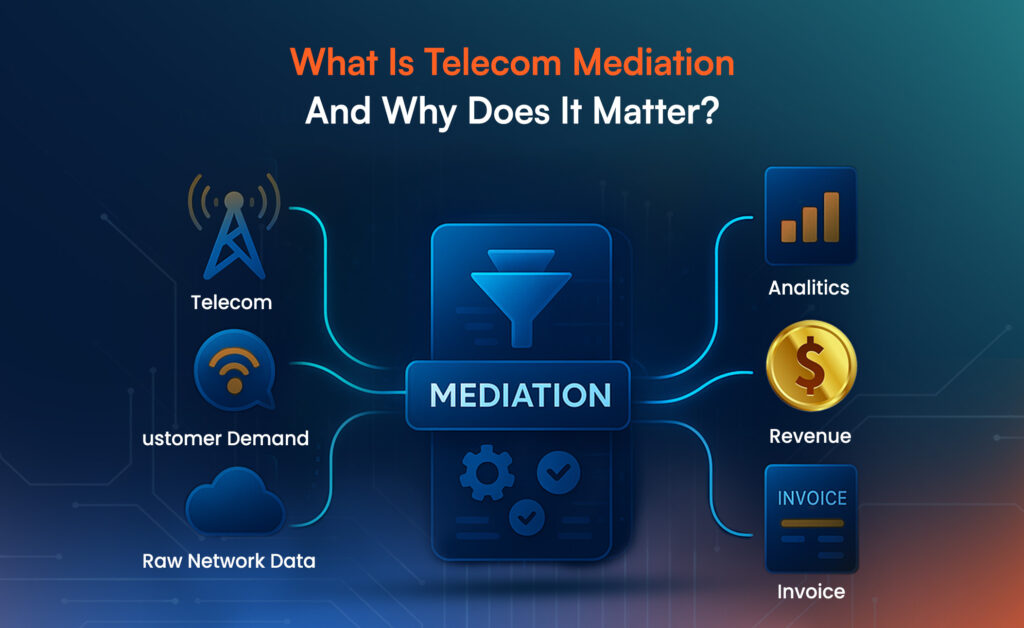
Telecom mediation is the process of collecting, filtering, validating, and transforming raw usage data from networks into a structured format that downstream systems can consume. According to Nokia, mediation consolidates usage data from any network type and then provides it to various OSS and BSS systems for billing, analytics, and other functions.
In practice, this means mediation systems sit between network elements and business support systems. They take in CDRs, event records, and session data, remove noise, apply business rules, and output clean records that a billing system, rating and charging engine, fraud engine, or data lake can understand.
Telecommunications mediation is often described as converting call data into predefined layouts that specific billing systems or OSS applications can import.
Without this mediation layer:
- Usage data arrives in inconsistent formats from many switches, gateways, and application servers.
- Billing systems struggle to interpret this data, which leads to misrated sessions and disputes.
- Revenue assurance has limited visibility into where leakage starts.
In short, telecom mediation is the quiet but essential bridge between your network and your revenue.
Core Components Of A Mediation System In Telecom
A modern telecom mediation platform does far more than simple file conversion. It acts as a full billing mediation and data processing layer.
| Mediation Function | What It Handles In Practice |
| Data collection | Receives CDRs, IP detail records, usage events, and logs from switches, gateways, policy servers, and partner systems. |
| Filtering and validation | Removes duplicates and non-billable records, checks mandatory fields, and flags corrupt data before it reaches billing. |
| Aggregation | Combines partial records into full sessions, for example multiple network events that together represent one call or data session. |
| Normalization | Maps vendor-specific fields to a common schema so BSS, telecom billing systems, and analytics platforms can interpret them. |
| Business rule transformation | Applies pricing zones, service identifiers, subscriber mappings, and partner codes needed by the rating engine. |
| Routing | Sends processed records to billing, revenue assurance, fraud detection, data lake integration, and reporting tools. |
This entire flow is often called the mediation layer. For high-volume providers, it must support real-time mediation so that online charging, policy control, and customer portals can work with near-live data.
How Telecom Mediation Protects Revenue And Customer Trust?
Telecom providers handle staggering amounts of usage data. One experience report by Research Gate describes processing around 6 billion CDRs per day for a single operator. At this scale, tiny data issues quickly add up to real money.
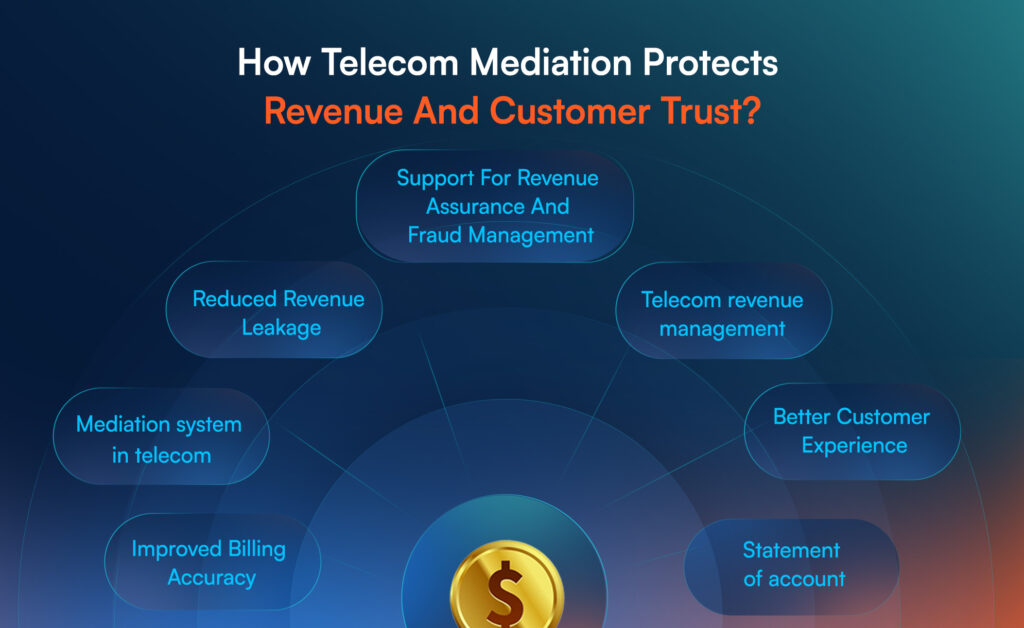
Improved Billing Accuracy
Telecom mediation reduces misbilled sessions by validating and normalizing records before they reach the billing engine.
A proper mediation system in telecom turns inconsistent CDR formats into standard records so the rating logic applies correctly. This cuts the number of manual bill adjustments and short-pays from enterprise customers.
Reduced Revenue Leakage
TM Forum’s Revenue Assurance Survey, cited by Ericsson, estimates telecom industry revenue leakage at around 1.5% of overall revenue.
Another analysis by Hubifi notes that companies worldwide lose around 9% of yearly income to revenue leakage, with telecom providers alone missing out on more than 30 billion dollars in a single year.
Mediation is one of the first places to fix this, since it decides which events even reach billing and revenue assurance.
Support For Revenue Assurance And Fraud Management
Clean, granular usage data is the base for telecom revenue management. Mediation feeds revenue assurance systems with complete records, making it easier to compare network usage with billed amounts. It also provides detailed data for fraud engines that must spot unusual patterns across billions of events.
Better Customer Experience
Accurate mediation reduces bill shock and disputes. When usage records are clear and consistent, customer care teams can explain charges with confidence, and enterprise customers are more likely to trust shared CDR reports and statement of account data.
Telecom Mediation In A 5G And Data-Heavy Environment
Traffic patterns are changing fast. ITU figures summarized by Sofrecom show global internet traffic at about 6174 billion terabytes in 2023, with fixed traffic expected to double and mobile traffic to triple by 2030. Ericsson forecasts around 5 billion 5G subscriptions by 2028, carrying roughly 70% of mobile data traffic.
For mediation, this means:
- More usage-based billing models, including pay-per-GB, QoS tiers, and consumption-based pricing for enterprise slices.
- Data coming from many platforms: 5G core, IoT gateways, cloud services, content partners, and cloud service brokerage platforms.
- A higher need for real-time or event-driven billing, where sessions are charged while in progress.
A static, file-based mediation system cannot keep up with this. Providers are moving toward API-first architecture, microservices, and data lake integration so mediation can scale horizontally and supply analytics teams with near-live information.
How To Choose A Telecom Mediation Platform?
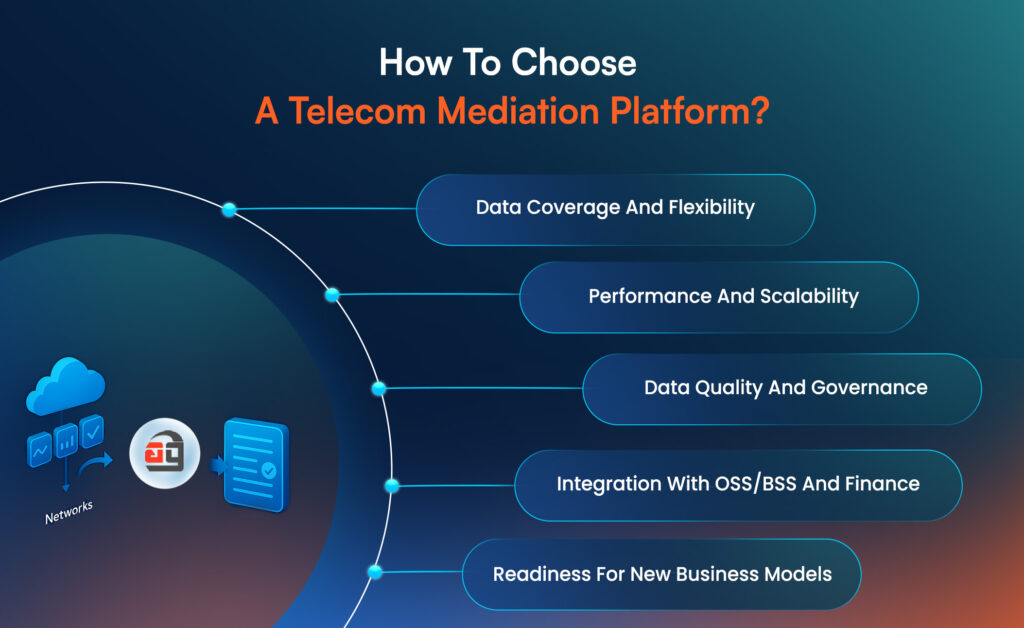
When you look at telecom mediation software, treat it as both a technical and financial decision. Here are the key factors to compare.
Data Coverage And Flexibility
Can the mediation system collect data from all relevant network types: mobile, fixed, VoIP, IoT, and partner platforms? Look for support for multiple CDR and event formats, along with configurable parsing rules instead of custom code each time. This is especially important for multi-tenant SaaS and cloud offerings where products change often.
Performance And Scalability
A good mediation layer should comfortably handle billions of usage events per day with headroom for growth. Ask vendors for benchmarks on CDR throughput, latency for real time rating, and support for horizontal scaling in cloud or hybrid environments.
Data Quality And Governance
Check how the platform manages validation, normalization, and error handling. Does it provide clear audit logs for regulatory and finance teams? Can you trace a billed event back through the mediation process for dispute handling or audit trail maintenance?
Integration With OSS/BSS And Finance
Mediation is not an island. You need ready integration with charging, telecom billing systems, CRM, GL integration, tax engines, and data warehouses. Support for webhook notifications, REST APIs, and iPaaS tools makes long-term operations easier.
Readiness For New Business Models
As you add cloud, UCaaS, CCaaS, IoT, and other digital services, mediation must adapt to new usage types without long projects. Look for configuration-driven mapping and support for subscription lifecycle events such as upgrades, downgrades, and trial periods.
Telecom Mediation Use Cases Across The Lifecycle
Telecom mediation appears in many real-world scenarios. Here are a few common ones.
- Convergent Billing For Quad-Play Operators: A converged operator offering mobile, fixed broadband, TV, and VoIP needs a single convergent billing view. Mediation collects usage from each network, aligns it to one customer profile, and feeds a unified invoice.
- MVNO And MVNE Ecosystems: MVNOs depend on wholesale usage data from host networks. A strong mediation system handles wholesale billing, retail usage, and partner reports so that both sides have clear settlement records.
- 5G And IoT Service Monetization: For 5G slices, private networks, and IoT platforms, mediation captures event data by device, application, or slice and maps it to enterprise contracts. This supports metered billing and committed use discounts for large customers.
- Cloud and SaaS Bundling: Operators that resell SaaS, UCaaS, and other digital services must ingest usage from cloud provider APIs. Mediation aligns that usage with subscription data and partner margins so downstream systems can calculate partner commission automation and revenue share.
- Revenue Assurance And Analytics: By feeding data lakes with normalized usage data, mediation supports churn analysis, usage analytics, and fraud models that look across telecom and cloud services at once.
Why Choose AppGallop For Telecom Mediation System?
Telecom providers that work with AppGallop often need mediation, charging, and reporting to work as a single flow, not as scattered tools.
AppGallop brings mediation-ready capabilities into its billing and marketplace stack so usage data from telecom and cloud services flows into one rating and invoicing engine.
AppGallop provides data and billing infrastructure that helps:
- Capture complete usage records through a mediation layer that collects events from telecom networks, cloud platforms, and partner services.
- Normalize and enrich CDRs so OSS, BSS, and finance teams work from the same source of truth.
- Support usage-based and subscription models with real-time rating, proration, and flexible tiered pricing models.
- Reduce revenue leakage by feeding revenue assurance and analytics with clean, detailed records and clear audit trails.
- Shorten time to launch new offers by using configuration for new product types instead of fresh custom mediation code each time.
AppGallop’s platform is designed to help CSPs and digital service providers move from fragmented mediation and billing to a connected telecom revenue management engine.
Providers using AppGallop report higher billing accuracy, faster invoice cycles, and better visibility into partner and customer usage, which directly helps long-term margin and growth.
Conclusion
Telecom mediation is not just an internal plumbing project. It is the foundation that lets CSPs, MVNOs, and digital service providers move confidently into 5G, IoT, and cloud services without losing money to bad data.
With traffic volumes rising rapidly and revenue leakage still measured in percentage points of total income, treating mediation as a core capability is a practical way to protect both margins and customer trust.
If you are planning a BSS upgrade, adding new digital services, or rethinking your telecom billing software stack, start by reviewing your mediation layer.
AppGallop can help you connect mediation, billing, and marketplace operations into one consistent platform so your network data turns into reliable, auditable revenue.
Frequently Asked Questions
Telecom mediation is the process of collecting, validating, and converting raw usage data from networks into structured records that billing, OSS, and analytics systems can use. A mediation system acts as a bridge between network elements and business platforms so that calls, data sessions, and other events are billed and reported correctly.
A mediation system in telecom is the software layer that automates data collection, filtering, normalization, and routing of usage records. It connects to switches, gateways, and service platforms, applies business rules, and then sends clean records to billing, revenue assurance, fraud detection, and analytics tools.
Telecom mediation helps reduce revenue leakage by catching errors early, before they enter billing or financial reporting. By validating and normalizing CDRs and other usage events, the mediation layer makes sure billable traffic is not dropped, misrated, or mis-assigned, which protects margins and reduces disputes.
Mediation and billing are connected but distinct. Mediation focuses on data preparation: it turns raw usage into clean records. Billing focuses on financial logic: rating, invoicing, discounts, taxes, and revenue recognition. Together, mediation and billing form a complete quote-to-cash chain, from network events to money in the bank.