



If you run a CSP, MSP, telco, or ISV, you already see how fast cloud spending is moving away from one-off projects to ongoing services. The global cloud services market was worth USD 618.04 billion in 2024 and is projected to reach USD 2,726.94 billion by 2034 (Precedence Research).
That growth usually does not happen through direct sales alone. It flows through partners, resellers, and service providers who sell cloud under their own brand.
White label cloud services make this possible. Instead of building data centers, billing stacks, and portals from scratch, you plug into a ready platform and present it as your own.
But three questions sit in the mind of every decision maker:
- Are we giving away margin by reselling another provider instead of owning the experience?
- Can we really run a branded cloud service with our current billing, support, and channel operations?
- How do we keep control of contracts, compliance, and revenue when someone else runs the infrastructure?
If these questions sound familiar, this guide is for you.
You will see what white label cloud services are, how they work, which business models fit different providers, and what to look for in a white label cloud platform.
Along the way, we will show how AppGallop helps you run a scalable, branded cloud marketplace without turning your team into a product engineering shop.
Key takeaways
- White label cloud services let CSPs, MSPs, telcos, and ISVs sell cloud infrastructure, software, and backup under their own brand while a third party runs the underlying platform.
- They suit providers that want to scale recurring revenue without building a new data center, billing stack, or multi-tenant SaaS platform.
- Strong offers combine white label cloud hosting, marketplace storefronts, and usage-based billing with solid revenue assurance and reconciliation automation.
- The right platform should support multi-tenant SaaS, cloud catalog management, service provisioning automation, and partner commission automation in one quote-to-cash flow.
What are White-Label Cloud Services?
White label products are goods or services produced by one company and rebranded by another as if they were its own. White label cloud services follow the same idea, but for infrastructure and software.
White label cloud services are pre-built cloud computing resources and platforms that a provider runs behind the scenes, allowing resellers, MSPs, or telcos to brand the service with their own logo, pricing, and customer experience.
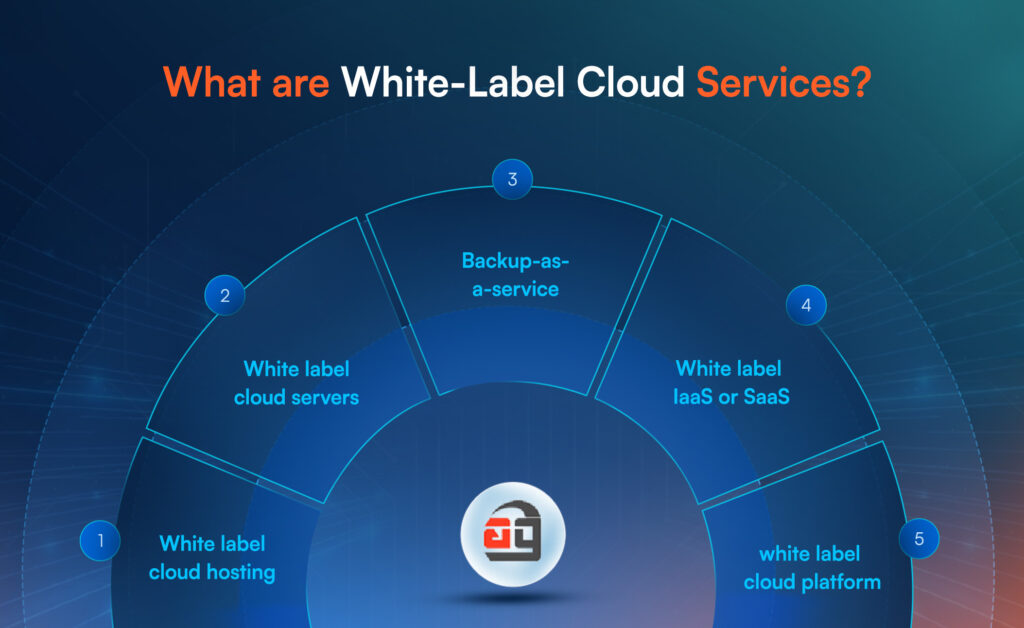
Typical offers include:
- White label cloud hosting for virtual machines, storage, and network resources
- White label cloud servers and backup-as-a-service
- White label IaaS or SaaS that partners bundle into broader managed service packages
- A white label cloud platform or marketplace that exposes all of this through branded portals
The reseller owns the customer relationship, sets prices, controls contracts, and delivers support at the front end.
The white label cloud provider handles infrastructure, uptime, scaling, and security at the back end.
Why White-Label Cloud Services are becoming more and more important?
The cloud market is expanding, but so is competition. The global cloud computing market is expected to grow from USD 752.44 billion in 2024 to USD 2,390.18 billion by 2030, at a 20.4 percent CAGR (Grand View Research).
At the same time, the global managed services market is forecast to reach USD 731.08 billion by 2030 (Grand View Research), as businesses offload more IT management to MSPs.
Most of that spending flows through channels instead of direct sales. Canalys estimates that partner-delivered IT technologies and services reached USD 3.4 trillion in 2023, accounting for more than 70 percent of global IT spending, as noted by Channel Futures
For CSPs, MSPs, and telcos, this creates a clear path:
- Own a cloud reseller business under your brand
- Package services in ways your local market understands better than hyperscalers
- Move from one-time projects to long-term recurring revenue management
White label cloud services give you a ready stack to do this without building your own hyperscale infrastructure.
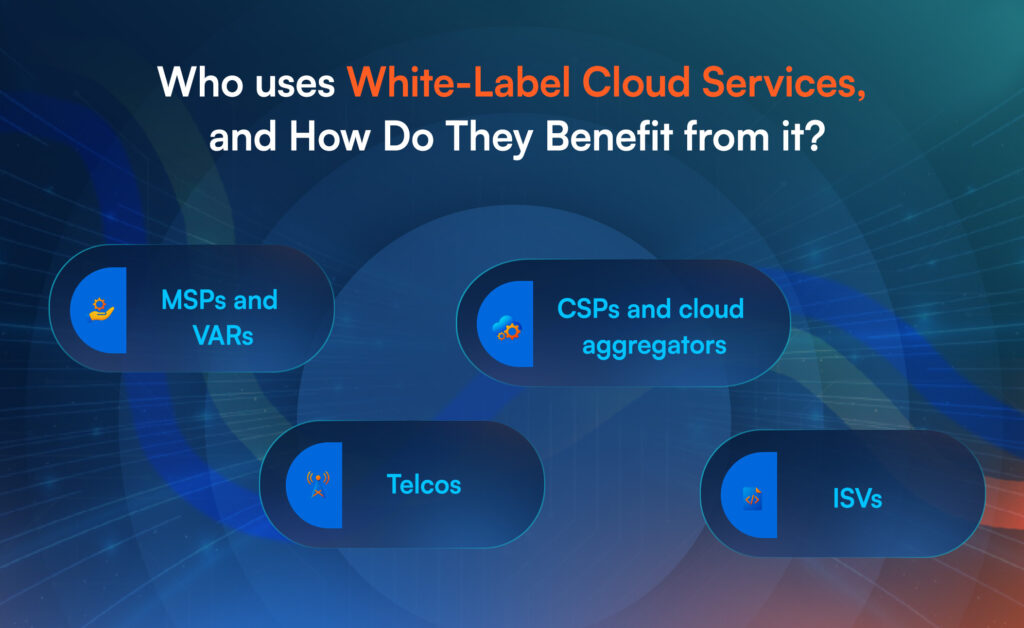
Who uses White-Label Cloud Services, and How Do They Benefit from it?
Different provider types use white label models for slightly different reasons.
MSPs and VARs
Managed Service Providers and Value-Added Resellers want to expand into cloud hosting and backup without heavy capital expense.
- They take a white label cloud reseller program from a provider.
- They bundle it with monitoring, migration, and helpdesk.
- They keep control of subscription lifecycle events and support, while their partner runs compute and storage.
For MSPs, this model plugs directly into their existing quote-to-cash and ticketing workflows.
CSPs and cloud aggregators
Cloud Solution Providers and cloud aggregators need more than hosting. They need full cloud service brokerage (CSB) functions.
- They run a branded white-label marketplace that lists IaaS, SaaS, and security solutions.
- They manage multi-tenant SaaS catalogs and resell hyperscaler services, often with usage-based billing and consumption-based pricing.
- They rely on cloud catalog management and service provisioning automation to keep order-to-activation time low.
Telcos
Telcos use white label cloud services to add cloud storage, backup, UCaaS, or security to their connectivity bundles without a long product build.
- They treat the white label platform as an extension of their BSS/OSS landscape.
- They look for convergent billing that combines traditional telecom services with new cloud offers.
- They depend on multi-currency billing and taxation logic for regional operations.
ISVs
Independent Software Vendors often need a ready infrastructure layer to go to market quickly in new regions.
- They bundle their SaaS on top of a white label cloud platform and offer it through partners.
- Multi-tenant SaaS capabilities help them serve many customers with isolated data while keeping costs in check.
Across all these segments, the goal is the same: shorten time to market, keep control of branding, and build higher-margin cloud revenue without owning a data center.
How White-Label Cloud Services Work End-to-End
At a high level, white label cloud services connect three parties: the underlying infrastructure provider, the reseller, and the end customer.
| Layer | Role in white label cloud services |
| Infrastructure provider | Runs data centers, hypervisors, storage, security controls, and base automation. Exposes everything through APIs and a management portal. |
| White label cloud provider/platform | Wraps infrastructure into a multi-tenant SaaS layer, adding account models, subscription logic, billing, and portals that can be branded. |
| Reseller (MSP, CSP, telco, ISV) | Configures branding, plans, bundles, and pricing. Manages customers, contracts, and first-line support. |
| End customer | Buys under the reseller’s brand, receives invoices from them, and interacts with their portal and support team. |
Under the hood, several functional blocks work together:
Multi-tenant SaaS and tenant isolation
The white label provider hosts many tenants on the same cloud infrastructure while keeping data isolated at the account, organization, or region level. This keeps costs down while protecting customer data.
Service provisioning automation
APIs and event-driven billing workflows handle provisioning and de-provisioning of services. When a reseller sells a new backup plan, for example, the platform automatically creates resources, applies policies, and updates entitlements.
Billing mediation and rating
Usage data flows into a mediation layer where it is cleaned, aggregated, and sent to rating and charging engines. These engines apply tariffs for storage, compute hours, bandwidth, or per-user licenses.
Partner and channel controls
If the white label offer supports N-tier distribution, partner margin rules, partner commission automation, and credit management sit inside the same system. That way, every sale through a reseller or sub-agent can be paid out correctly.
Business Models for White-Label Cloud Providers and Resellers
Different organizations enter white label cloud services with different goals. The table below maps common business models.
Most providers use a mix of these models over time as they expand their cloud reseller business.
Billing and revenue operations for white label cloud services
Scaling white label cloud services is less about spinning up servers and more about handling money accurately.
The cloud managed services market is projected to grow from USD 155.73 billion in 2025 to USD 482.93 billion by 2034. That growth depends on tight billing and revenue assurance.
Key disciplines include:
- Usage-based billing and metered billing: White label offers often price cloud resources on consumption. Accurate mediation systems are needed to fetch usage events, apply rates, and handle minimum commitments or consumption overage charges.
- Proration billing and subscription lifecycle events: When a customer upgrades mid-cycle or adds new users, proration billing calculates partial charges and credits for that period. Handling subscription lifecycle events like upgrade, downgrade, and cancellation correctly avoids revenue leakage.
- Multi-currency billing and tax logic: For providers selling in many countries, invoices must include local currency, VAT or GST, and regional sales tax. Systems with built-in multi-currency billing and sales tax automation reduce manual finance work and errors.
- Revenue recognition automation and ASC 606 compliance: When deals include setup fees, recurring components, and usage, revenue recognition rules become complex. Automation aligned with ASC 606 compliance and IFRS 15 compliance keeps auditors satisfied and prevents misstatements.
- Dunning management and collections workflow automation: Failed card payments or overdue invoices can quickly damage margins. Structured dunning management and collections workflows recover revenue while keeping customer relationships healthy.
For many CSPs, MSPs, and telcos, these functions are the hardest part to build in-house. That is why a good white label cloud platform must include strong revenue operations features, not only infrastructure.
Partner and Channel Management in White-Label Cloud
Channel partners are central to cloud growth. Estimates suggest the big three public cloud providers already hold around 73 percent of the US market and rely heavily on partners to reach customers (Altman Solon).
In this context, white label cloud services help you grow a partner ecosystem instead of competing with it.
Important ideas:
- Multi-tier distribution lets you support distributors, resellers, and sub-agents on one stack.
- Partner lifecycle management tracks onboarding, enablement, performance, and offboarding.
- Partner discount schedules and channel margin management keep pricing aligned with partner tiers.
- Partner commission automation and sub-agent commissions keep payouts accurate across N-tier hierarchies.
- Partner portal management gives each partner its own login, marketplace view, and reporting, often supported by tenant isolation.
According to Canalys, partner-delivered IT technologies and services reached USD 3.4 trillion in 2023, more than 70 percent of total IT spending. For a white label cloud provider, this means the platform must treat partners as first-class users, not a side feature.
What should you look for in a White-Label Cloud Services Platform?
When you evaluate a white label cloud provider or platform, it helps to map requirements into five groups.
1. Infrastructure and reliability
You want a platform that:
- Runs on proven data centers or hyperscaler infrastructure
- Offers strong backup and disaster recovery options for white label workloads
- Provides clear SLAs and transparent performance reporting
2. Marketplace and catalog features
For CSP and telco use cases, marketplace capabilities matter as much as hosting:
- Multi-cloud catalog management with ready SKUs for IaaS, SaaS, and security
- Product bundling engine to create combined offers
- Support for private offer management and contract-based pricing
- Self-service procurement for customers and partners, backed by approval workflow engines
3. Billing and finance operations
Look for:
- Flexible rating and charging engines that support subscription, usage, and hybrid pricing
- Multi-currency billing with VAT/GST management
- Revenue recognition automation and deferred revenue scheduling
- Reconciliation automation for payments, cloud provider invoices, and partner settlements
- Statement of account reporting for every customer and partner
4. Partner and channel controls
Your white label stack should help, not hinder, channel growth:
- Two-tier or N-tier distribution support
- Credit control and dynamic credit management
- Deal registration system and partner performance scorecards
- Channel incentive programs and SPIFFs support
- Partner ROI tracking and influenced deal tracking
5. Integration and technical architecture
Finally, check how the platform plugs into your broader stack:
- API-first architecture and webhook notifications for real-time updates
- iPaaS or native connectors for CRM, ERP, and ticketing
- SSO and RBAC to control access across internal teams and partner organizations
- Data lake integration for advanced marketplace analytics and usage analytics
When these areas line up, you get a platform that supports cloud distribution at scale, not just a rebranded control panel.
How AppGallop provides The Best White-Label Cloud Services?
White label cloud services work best when branding, marketplace operations, billing, and partner management sit on one platform. AppGallop does exactly that for CSPs, MSPs, telcos, and ISVs.
AppGallop provides ready marketplace and billing infrastructure that helps you:
- Launch branded marketplaces fast with white-label storefronts, self-service portals, and multi-tenant SaaS controls.
- List and bundle offers across clouds using cloud catalog management, product bundling, and support for IaaS, SaaS, devices, and services.
- Run accurate billing and revenue operations with usage-based billing, proration billing, multi-currency billing, and automated revenue recognition for ASC 606 compliance.
- Grow channel partnerships using N-tier partner hierarchy management, partner commission automation, and credit management for distributors and resellers.
- Automate provisioning end-to-end with service provisioning automation, order-to-cash workflows, and integrations into CRM, ERP, and BSS/OSS systems.
Providers using AppGallop have launched white label marketplaces in as little as six weeks and expanded solution portfolios several times over while keeping billing accuracy very high.
Instead of stitching together separate tools for marketplace, billing, and partner payouts, teams control the full quote-to-cash motion from one place.
Still not convinced? Book a Free Demo Call Today!
Common problems faced in starting with White-Label Cloud Services
Even strong providers struggle when they treat white label cloud as “just another product”. Watch out for these patterns:
Treating it as pure infrastructure resale
If you simply resell compute at thin margins, hyperscalers will always win on price. The value comes from packaging, support, and bundles that solve real problems for SMB customers.
Ignoring revenue leakage and reconciliation
Manual spreadsheets for usage and commission calculations invite errors. Investing early in revenue assurance, reconciliation automation, and audit trail maintenance saves a lot of pain later.
Underestimating partner operations
Running a two-tier distribution model without strong channel data synchronization and partner performance scorecards usually leads to disputes and missed incentives.
Delaying integration work
When billing, CRM, and support systems stay disconnected, customers receive inconsistent invoices and messages. API orchestration and event-driven billing should be part of the initial plan, not a later fix.
Conclusion
White label cloud services give CSPs, MSPs, telcos, and ISVs a practical way to build recurring cloud revenue under their own brand. You tap into proven infrastructure, shorten time to market, and focus on packaging, support, and channel strategy instead of building a platform from scratch.
The opportunity is growing fast. Cloud services, managed services, and channel-delivered IT spend are all moving upward at double-digit rates. Providers that combine strong offers with solid billing, partner management, and marketplace operations will capture more than one-off resale margins. They will own long-term customer relationships.
White label cloud services are cloud infrastructure and software that one company runs while another brands and sells them as its own. The white label provider handles data centers, scaling, and security, and the reseller controls pricing, packaging, support, and customer contracts. This gives partners a fast path to launch cloud offers without building a platform.
A white label cloud reseller program is a partnership model where MSPs, CSPs, telcos, or ISVs resell cloud hosting, backup, or SaaS under their own brand. The program usually includes branded portals, wholesale pricing, and tools for provisioning and billing, so the reseller can act as the primary provider for its customers.
Regular cloud hosting often exposes the original provider’s brand, portals, and billing directly to the end customer. With white label cloud services, the end customer sees only the reseller’s brand, invoices, and support. The underlying provider stays invisible and focuses on running the infrastructure and platform while the reseller owns the relationship.
Starting a white label cloud hosting business begins with picking a white label cloud provider or platform that fits your target market. From there, you define your service catalog and pricing, configure branding and tenant settings, connect billing and payment gateways, and roll out offers to initial customers or partners. Platforms like AppGallop help with marketplace setup, usage-based billing, and partner commission automation, so you can focus on sales and support.