



MVNOs are no longer niche players. The global mobile virtual network operator (MVNO) market is projected to grow from around USD 78 billion in 2022 to more than USD 137 billion by 2030, at close to 8% CAGR (cited by: PR Newswire).
At the same time, the number of active MVNOs keeps climbing. By 2025, there were more than 2,100 MVNOs operating across 100 markets worldwide, more than double the count of traditional network operators (source: Wikipedia). Competition is intense, margins are thin, and the only sustainable edge is how fast you can launch offers and how accurately you can bill for them.
That is where a modern MVNO billing platform becomes mission-critical. It sits at the centre of your prepaid, postpaid, hybrid, IoT, and wholesale models, connecting usage data, pricing rules, offers, partners, and revenue.
If you are running or launching an MVNO today, you are probably asking:
- How do we handle complex prepaid and postpaid bundles without errors or revenue leakage?
- How can we launch new plans, partners, and services in weeks instead of quarters?
- How do we give finance and operations a single, reliable view of revenue, tax, and settlements?
This guide explains what an MVNO billing platform is, why billing is so complex in MVNO environments, the capabilities you should expect from a modern solution, and how AppGallop helps MVNOs move from patchy systems to a scalable, cloud-native billing stack.
Key Takeaways
- MVNOs need specialised billing software to handle high-volume, usage-based services, complex tariffs, and multi-party revenue sharing.
- Legacy billing systems slow down product launches, create manual work, and increase the risk of revenue leakage and compliance issues.
- A modern MVNO billing platform should offer real-time rating and charging, convergent prepaid/postpaid support, mediation, invoicing, revenue assurance, and partner settlement in one place.
- AppGallop provides a cloud-native MVNO billing platform designed for digital-first MVNOs, IoT and B2B providers, and telco sub-brands who sell through CSP marketplaces and direct channels.
- Choosing the right platform means focusing on configurability, time-to-market, ecosystem integration, and total cost of ownership – not just licence price.
What Is An MVNO Billing Platform?
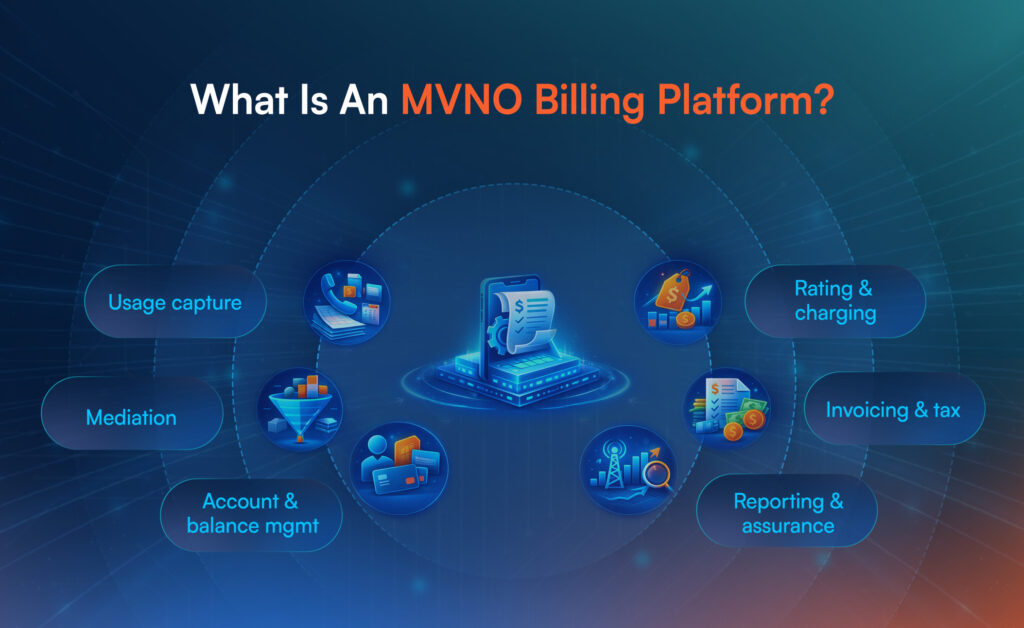
An MVNO billing platform is specialised telecom billing software built for mobile virtual network operators. It combines:
- Usage capture and mediation of call detail records (CDRs) and data records from the host MNO and other sources.
- Rating and charging for voice, SMS, data, roaming, and value-added services using complex tariffs.
- Account, subscription, and balance management for prepaid, postpaid, and hybrid accounts.
- Invoicing, taxation, and collections across regions and currencies.
- Reporting, analytics, and revenue assurance to track performance and detect leakage.
Unlike generic SaaS billing software, an MVNO billing solution must understand telecom-grade volume, 3G/4G/5G network events, and regulatory rules while still giving product and finance teams business-friendly controls.
Why MVNO Billing Has Become So Complex
MVNOs sit between wholesale network providers, partners, and end customers. Billing touches all three. Complexity keeps increasing because:
- MVNOs sell bundled offers that mix voice, SMS, data, Wi-Fi, OTT content, roaming, and sometimes financial or IoT services.
- Customers expect real-time balances and notifications for prepaid and hybrid plans.
- Each host MNO has its own wholesale pricing, discounts, and settlement rules.
- MVNOs often expand into new geographies with different tax rules, currencies, and regulatory requirements.
- Many MVNOs run parallel systems: an old rating engine, separate CRM, spreadsheets for partner settlement, and manual finance processes.
The result is familiar: billing errors, delayed invoices, disputes with partners, and difficulty understanding profitability by segment or plan.
A modern MVNO billing platform is designed to absorb this complexity and present it as configurable business rules instead of custom code and spreadsheets.
Core Capabilities Of A Modern MVNO Billing Platform
A cloud-native MVNO billing platform should give you a single place to model offers, process usage, and recognize revenue, while staying flexible enough for new services. Key capabilities include:
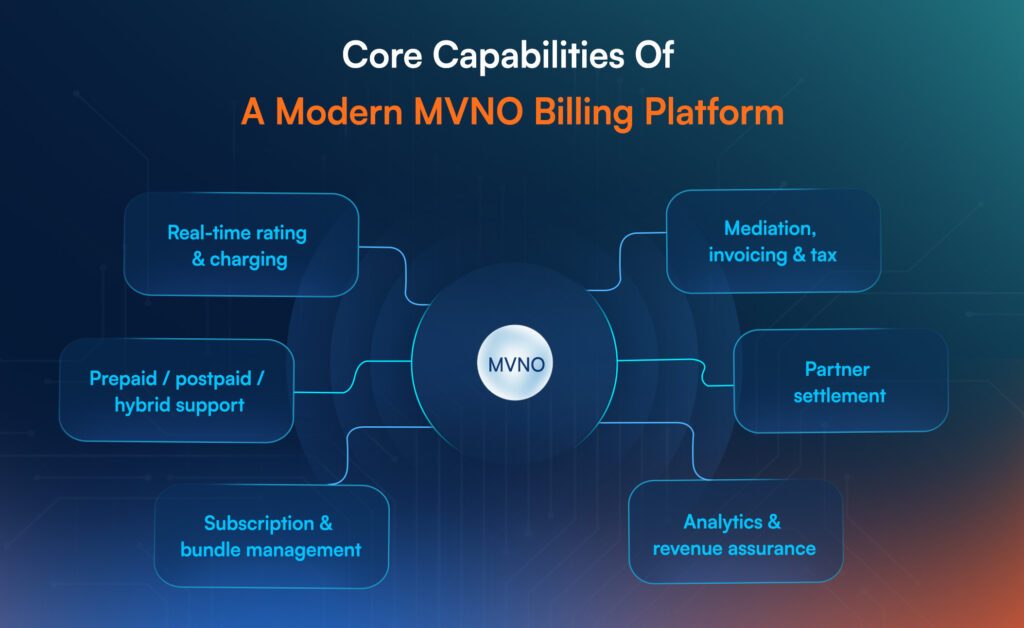
Real-Time Rating And Charging
The platform should rate usage events in real time, applying tariffs, discounts, and bundles across:
- Voice, SMS, data, and roaming
- Fair-usage policies and throttling
- Time-of-day, location, or network-based pricing
Real-time charging lets you update balances immediately and avoid bill shock, an important factor for prepaid and hybrid MVNOs.
Flexible Prepaid And Postpaid Billing
MVNOs rarely run a single model. The same billing engine should handle:
- Pure prepaid offers with real-time balance control
- Postpaid accounts with monthly invoices and credit control
- Hybrid models where customers top up but also receive invoices
- B2B accounts with shared bundles across teams or devices
Subscription, Usage, And Bundle Management
You need catalogue-driven control over:
- Plans, add-ons, bolt-ons, and promotions
- Shared and family bundles
- Introductory discounts and loyalty rewards
- Upsell and cross-sell paths as usage grows
Product teams should be able to configure these without raising development tickets each time.
Mediation, Invoicing, And Tax
The platform should collect records from the host MNO and other network elements, normalise them, and pass only clean data into rating. It must also handle:
- Multi-currency invoicing
- Local tax rules and surcharges
- Itemised bills with clear usage breakdown
Partner Settlement And Revenue Sharing
MVNOs work with MNOs, content partners, resellers, and channel partners. Your billing system should:
- Calculate wholesale charges and interconnect fees
- Apply revenue-sharing rules for partners and resellers
- Produce settlement reports that finance can trust
Analytics, Reporting, And Revenue Assurance
Finally, you need a clear view into:
- ARPU, churn, and plan-level profitability
- Unbilled usage and revenue leakage risks
- Collection performance and ageing
- Network usage trends that impact wholesale costs
Common Billing Challenges MVNOs Face (And Their Impact)
Even successful MVNOs often struggle with billing. Typical issues include:
- Slow Time-To-Market: Launching a new plan or bundle can take months because tariffs are hard-coded across multiple systems. Competitors move faster.
- Revenue Leakage: Inconsistent rating rules, missing usage records, or manual adjustments mean not all usage is billed correctly, which quietly erodes margins.
- Limited Prepaid/Postpaid Convergence: Separate stacks for prepaid and postpaid make it hard to offer hybrid plans or give customers a single bill.
- Manual Partner Settlement: Wholesale invoices and partner payouts are reconciled in spreadsheets, increasing disputes and finance workload.
- Poor Visibility: Leadership teams don’t get timely, reliable reports on plan-level profitability or customer behaviour, making it hard to decide where to invest.
A purpose-built MVNO billing platform is meant to remove these roadblocks so your team focuses on growth, not reconciliation.
Legacy Vs Modern MVNO Billing Platforms
A quick comparison shows why many MVNOs are moving from legacy systems to cloud-native platforms.
| Area | Legacy MVNO Billing System | Modern Cloud-Native MVNO Billing Platform |
| Deployment | On-prem, customised per operator | Multi-tenant cloud with configuration over code |
| Product Launch Speed | Weeks or months for tariff changes | Days for new plans and bundles via catalogue configuration |
| Prepaid/Postpaid Support | Often separate systems | Convergent engine for prepaid, postpaid, and hybrid |
| Integrations | Point-to-point, brittle | API-first with standard connectors and webhooks |
| Partner Settlement | Manual spreadsheets and custom reports | Built-in settlement rules and automated reports |
| Upgrades And Maintenance | Expensive, high-risk projects | Continuous updates with minimal downtime |
| Visibility And Analytics | Static reports, limited self-service | Near real-time dashboards and self-service analytics |
How AppGallop Helps MVNOs Build A Future-Ready Billing Stack?
AppGallop is built for digital-first CSPs, MSPs, telcos, and MVNOs that need agile, multi-product billing – including those selling through hyperscaler marketplaces as well as direct channels.
For MVNOs, AppGallop offers:
- Real-Time Rating And Charging: A telecom-grade engine for voice, SMS, data, and 5G services with support for complex bundles, promotions, and roaming.
- Convergent Prepaid And Postpaid Billing: One platform for prepaid, postpaid, hybrid, and B2B shared plans, with unified balances and account views.
- Catalogue-Driven Offer Management: Product teams can configure plans, add-ons, and discounts without custom development, cutting launch cycles from months to weeks.
- Partner And Reseller Settlement: Built-in rules to manage wholesale pricing, interconnect fees, and revenue sharing with MNOs, MVNEs, content partners, and resellers.
- Marketplace-Ready Billing: Native support for cloud marketplace-style models – usage-based billing, committed spend, and private offers – so MVNOs that also sell digital services can monetise through CSP marketplaces.
- Analytics And Revenue Assurance: Dashboards for ARPU, churn, unbilled usage, and profitability by plan, segment, or partner, so finance and leadership teams get a single source of truth.
Because AppGallop is cloud-native and API-first, it sits comfortably alongside your CRM, self-care apps, and OSS/BSS stack instead of forcing a full rip-and-replace on day one.
Fill this Form to Book a Free Demo with AppGallop Today!
How To Choose The Right MVNO Billing Platform?
When you assess MVNO billing software, look beyond feature checklists. Focus on:
- Time-To-Launch: How quickly can you introduce a new tariff, bundle, or partner offer with real examples?
- Configurability: Can business users manage most changes through a catalogue, or is every change a development project?
- Scalability: Will the platform handle higher subscriber volumes, IoT devices, and new regions without re-architecture?
- Integration Fit: Does it provide clean APIs and event streams to connect with CRM, self-care, payment gateways, mediation, and marketplaces?
- Compliance And Tax: How does it support local tax rules, invoicing standards, and audit requirements across markets?
- Total Cost Of Ownership: Include licences, infrastructure, integration, and the internal effort spent on change requests and operations.
A platform that checks these boxes may look more expensive upfront but usually saves cost and effort once you factor in faster launches and lower leakage.
MVNO Billing Use Cases Where Modern Platforms Shine
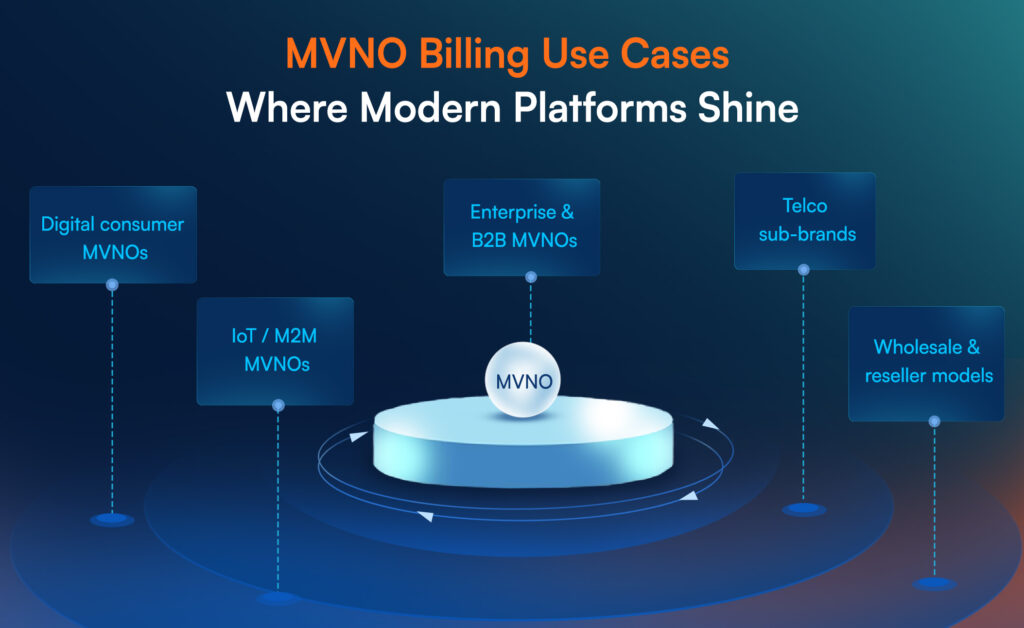
A modern MVNO billing platform unlocks value across several scenarios:
- Digital Consumer MVNOs: Fast experimentation with data-heavy plans, app bundles, and youth or segment-focused offers.
- IoT And M2M MVNOs: Large numbers of low-ARPU devices with event-based billing, SIM lifecycle management, and shared connectivity bundles.
- Enterprise And B2B MVNOs: Custom contracts, shared corporate bundles, site-level billing, and integration with enterprise invoicing and procurement.
- Sub-Brands And Flanker Brands: Telcos launching digital-only or value brands that need a separate, agile billing stack without disturbing the core BSS.
- Wholesale And Reseller Models: MVNOs that host other brands or resellers and must handle multi-layer revenue sharing and reporting.
Getting Started With AppGallop
If you are exploring a new MVNO launch or modernising an existing operation, a good starting point is to map:
- Your current products, bundles, and subscriber segments.
- The systems involved in rating, charging, invoicing, and settlement today.
- The manual work your team does every month to close the books or launch offers.
AppGallop’s team can then line this up against the platform’s capabilities, highlight quick-win migrations (such as new digital sub-brands or selected segments), and phase the rest to minimise risk.
Conclusion: Turn Billing Into A Growth Lever For Your MVNO
MVNOs now operate in a crowded, fast-moving market with thousands of competitors, more than double the number of traditional network operators worldwide. In this environment, billing is not just an operational system; it is the engine that determines how quickly you can launch offers, how accurately you capture revenue, and how confidently you can grow.
A modern MVNO billing platform gives you that engine – combining real-time rating, convergent prepaid/postpaid support, mediation, invoicing, partner settlement, and analytics in one cloud-native stack.
AppGallop is built to deliver exactly this for digital MVNOs, IoT providers, B2B players, and telco sub-brands. If you want billing to stop being a bottleneck and start acting as a growth lever, this is the moment to rethink your platform – and AppGallop is ready to help.
Frequently Asked Questions About MVNO Billing Platforms
An MVNO billing platform is specialised telecom billing software that handles usage collection, rating, charging, invoicing, and partner settlement for mobile virtual network operators. It is designed for telecom-grade volume and complexity while still giving business teams control over tariffs and offers.
MVNO billing is different because the operator does not own the radio network and must work with wholesale pricing and settlement rules from one or more host MNOs. The billing system needs to manage both retail customer charges and wholesale costs, often across multiple markets, while still providing standard telecom functions like prepaid, postpaid, and roaming billing.
Yes, modern convergent MVNO billing platforms support prepaid, postpaid, and hybrid accounts on a single rating and charging engine. This lets you offer flexible bundles, move customers between models without migration projects, and present a unified view of balances and invoices.
An MVNO should look for real-time rating, convergent prepaid/postpaid support, strong mediation, partner settlement, and revenue assurance features. It is also important to check how easily business teams can configure new offers, how the platform integrates with CRM and self-care apps, and whether it scales across multiple regions and segments.
AppGallop provides a cloud-native MVNO billing platform with real-time charging, catalogue-driven product management, convergent prepaid/postpaid support, and built-in partner settlement. It is API-first, so MVNOs can connect it to existing CRM, self-care, and payment systems, and it offers analytics that help finance and leadership teams understand revenue, margins, and growth opportunities.