




Subscription businesses are no longer a side project. The subscription economy has grown by 437% since 2012 (Zuora Subscription Economy Index), showing how fast recurring models are replacing one-time deals (Source: TechTarget).
For CSPs, MSPs, telcos, and ISVs, this shift creates new revenue, but it also adds complexity. You need a subscription marketplace that can handle recurring offers, usage-based pricing, partner channels, and billing rules without drowning your team in manual work.
Before you think about features or platforms, ask yourself:
- Are you losing deals because customers cannot buy, modify, or renew subscriptions in one place?
- Do finance and operations teams spend nights fixing usage files, credit notes, and missed renewals?
- Are partners asking for their own storefront and clear commission views, while you still send spreadsheets?
A subscription marketplace solves these problems by giving buyers, partners and finance one shared system for marketplace subscriptions, billing and lifecycle management.
This guide explains what a subscription marketplace is, how the subscription marketplace model works for B2B cloud and telecom providers, and what to look for in a platform that can scale with you.
Key Takeaways
- A subscription marketplace is a digital hub where multiple vendors sell recurring products and services in one place.
- For CSPs, MSPs, telcos, and ISVs, it becomes the base for subscription commerce, usage-based billing, and partner sales.
- Strong subscription marketplace models focus on catalog design, recurring billing, self-service, and channel programs together.
- Without this layer, teams face revenue leakage, poor partner experience and limited visibility for finance and leadership.
What Is A Subscription Marketplace?
A subscription marketplace is a digital platform where many providers list products or services that customers buy on a recurring basis.
Instead of visiting separate portals for SaaS, security, voice, backup, or connectivity, buyers browse, compare, and subscribe in one online subscription marketplace.
Most articles talk about consumer examples, but the same idea fits B2B subscription commerce. A CSP or telco can host cloud services, UCaaS, security bundles, storage, devices, and support plans together, then bill customers monthly based on active subscriptions and usage.
The opportunity is large. The global subscription ecommerce market is projected to grow from 278.0 billion in 2024 to 6,369.8 billion by 2033 at a 41.4% annual rate (IMARC). That is far beyond media and entertainment; B2B software, infrastructure, and services are a big share of this shift.
In this context, a subscription marketplace platform is more than a shopping cart. It usually includes:
- Multi-tenant SaaS architecture so you can host many vendors, customers, and partners on one stack.
- Catalog tools that support SaaS, IaaS, devices, and services in one place, including bundles.
- Pricing support for recurring billing, usage-based billing, and hybrid models.
- Subscription management for upgrades, renewals, co-term changes, and cancellations.
- Self-service procurement, where buyers add, change, and remove subscriptions without tickets.
When this is designed well, buyers see a simple marketplace subscription view, while your back office tracks complex metering, taxation, revenue recognition, and partner payouts behind the scenes.
Why Subscription Marketplaces Matter For B2B Cloud And Telecom Providers?
For CSPs, MSPs, and telcos, recurring revenue is already the default. The challenge is not selling subscriptions, but managing thousands of them across services, tenants, and partners.
Digital buying behavior adds pressure. Gartner expects that by 2025, 80% of B2B sales interactions between suppliers and buyers will happen in digital channels (Gartner).
McKinsey also reports that nearly two-thirds of corporate buyers now rely on digital and remote channels through the full purchasing journey (McKinsey & Company).
That means buyers expect:
- A single portal for all their recurring services.
- Transparent pricing and usage information.
- Instant provisioning and changes without email chains.
- Simple invoice lines that match what they actually use.
On the provider side, finance leaders are also reacting to subscription growth. The global subscription and billing management market is forecast to grow from about 7.98 billion in 2025 to 18.23 billion by 2030 at a 16.2% annual rate (Mordor Intelligence). This spend is going somewhere: either into your own tech stack or into your competitors’ platforms.
A well-designed subscription marketplace helps you:
- Bring cloud service brokerage (CSB), subscription commerce, and partner sales into one place.
- Shorten the quote-to-cash path for complex subscription marketplace models.
- Reduce manual corrections around proration billing, tax, and currency handling.
- Offer partners their own storefronts and clear commission views.
- Collect data for health score monitoring, renewal automation, and expansion revenue tracking.
Without that layer, sales, finance, and operations teams stay stuck in spreadsheets even as deal volume grows.
Subscription Marketplace Models For CSPs, MSPs, And ISVs
There is no single subscription marketplace model. Most B2B providers follow one of three patterns, often evolving from left to right as their business matures.
| Subscription Marketplace Model | How It Works | Where It Fits Best |
| Single-vendor subscription marketplace | One vendor offers its own SaaS or telecom products as recurring plans with add-ons. | Early-stage ISVs or telcos are standardizing their own offers. |
| Multi-vendor subscription marketplace | Many ISVs, telco services, and device vendors list offers. The operator owns customer relationships and billing. | CSPs, distributors, and telcos running cloud distribution or cloud aggregation. |
| Partner-led marketplace subscription | Distributor or CSP runs the base platform, while VARs and MSPs run their own storefronts under a white-label model. | Two-tier distribution and master agent programs. |
In all three models, a platform must handle:
- Flexible pricing for recurring, usage, and hybrid models.
- Entitlement management so customers see the right offers and limits.
- Partner commission automation for multi-tier distribution.
- Approval workflow engines for large enterprise orders.
When you pick a subscription marketplace platform, think less about design templates and more about how each model maps to your current and future channel strategy.
Today, you might only host first-party offers. Tomorrow, you might run a multi-vendor subscription marketplace where dozens of ISVs sell through your reach.
Operational Challenges Without A Subscription Marketplace Layer
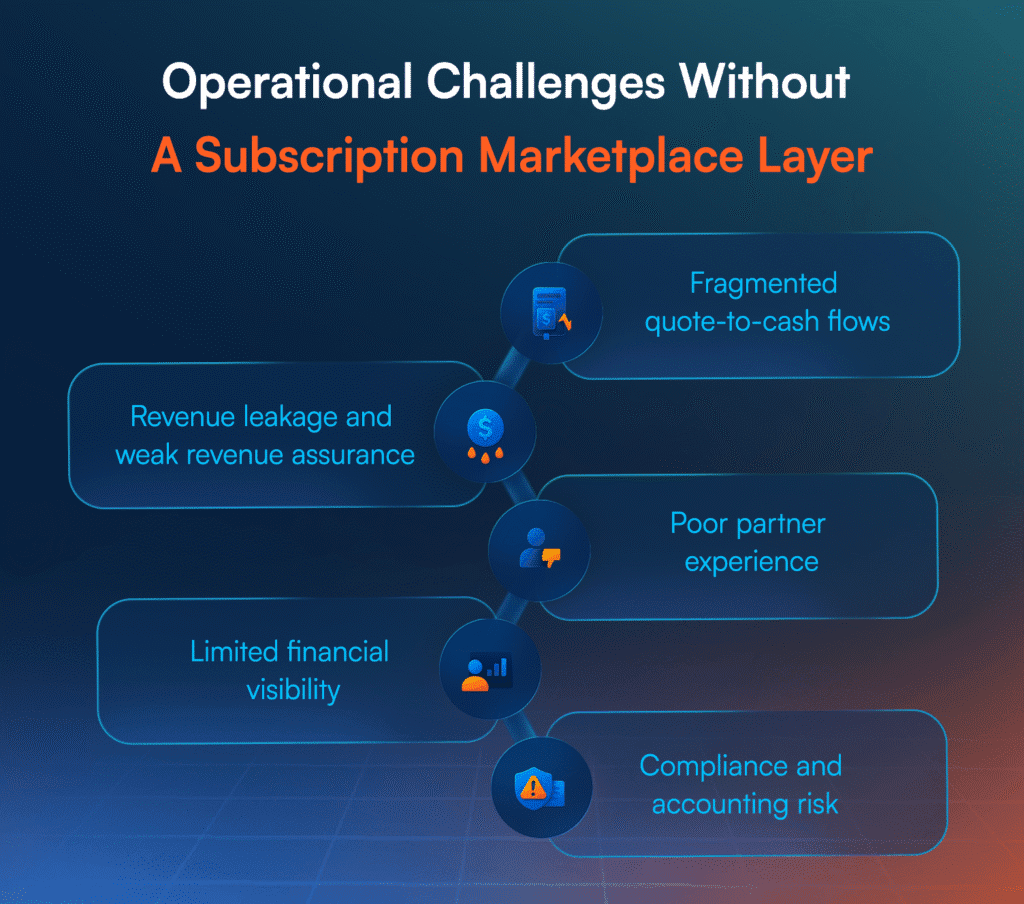
Many CSPs and telcos try to handle subscription commerce through CRM customizations, homegrown portals, and manual billing scripts. That approach looks cheaper at first, but the hidden cost grows fast.
- Fragmented quote-to-cash flows: Sales teams close deals in CRM. Operations teams provision through separate tools. Finance teams bill through ERP.
Every handoff adds delays and errors, especially as subscription lifecycle events like upgrades, co-term changes, and cancellations pile up.
- Revenue leakage and weak revenue assurance: When usage metering, mediation systems, and rating engines sit outside a structured marketplace, small gaps appear.
Missing usage files, incorrect charge codes, and outdated price books slowly hit the margin. Over time, this turns into measurable revenue leakage detection findings during audit trail maintenance.
- Poor partner experience: Indirect channels expect a clear partner lifecycle management flow: onboarding, learning, selling, getting paid.
If they need to email for every quote, order, and commission question, your indirect sales channel cannot scale.
- Limited financial visibility: CFOs want accurate recurring revenue management views by product, vendor, region, and partner.
Without a real subscription marketplace platform, finance teams patch together data from billing, ERP, and CRM, delaying close cycles and making multi-entity accounting harder.
- Compliance and accounting risk: As contract terms grow more complex, rules like ASC 606 and IFRS 15 need proper revenue recognition automation.
Manual spreadsheets for deferred revenue scheduling and contract changes are hard to audit and easy to misplace.
A true subscription marketplace layer reduces these risks by giving sales, partners, finance, and operations one shared structure rather than scattered scripts.
Key Capabilities To Look For In A Subscription Marketplace Platform
When you evaluate platforms, it helps to map features to the jobs your teams are trying to get done. Use the view below as a checklist.
| Capability Area | What To Look For | Why It Matters |
| Catalog and Bundling | Cloud catalog management, product bundling engine, support for SaaS, devices, and services in one structure. | Let’s you build bundled offerings that match how customers buy, not how vendors ship SKUs. |
| Pricing And Billing | Usage-based billing, metered billing, proration billing, and arrears billing in the same engine. | Supports subscription marketplace models where some items are flat, and others are consumption-based. |
| Revenue And Finance | Revenue recognition automation, dunning management, reconciliation automation, and multi-currency billing. | Keeps recurring billing accurate while finance teams meet ASC 606 and IFRS 15 compliance needs. |
| Partner And Channel | Multi-tier distribution, partner commission automation, partner portal management, and deal registration systems. | Let’s distributors, VARs, and MSPs sell subscriptions at scale while still protecting margin. |
| Architecture And Integration | API-first architecture, webhook notifications, CRM and ERP integration, tenant isolation, and SSO support. | Keeps your subscription marketplace connected to quote-to-cash, GL integration, and identity systems. |
| Analytics And Growth | Usage analytics, marketplace analytics, renewal automation triggers, and expansion revenue tracking. | Helps sales and success teams spot upsell paths and negative churn opportunities early. |
Look for vendors that treat subscription marketplace operations as a full business stack: catalog, billing, finance, partners, and data.
A simple shopping plugin may work for a small online subscription marketplace, but complex B2B subscription commerce needs deeper billing hierarchy management, subscription lifecycle events, and contract management built in.
How AppGallop Helps Subscription Marketplace Success?
AppGallop is built for providers who want to run a serious subscription marketplace across cloud, telecom, and ISV services.
It brings marketplace infrastructure, billing, and channel programs into one platform, so you do not need separate stacks for commerce, billing, and partner portals.
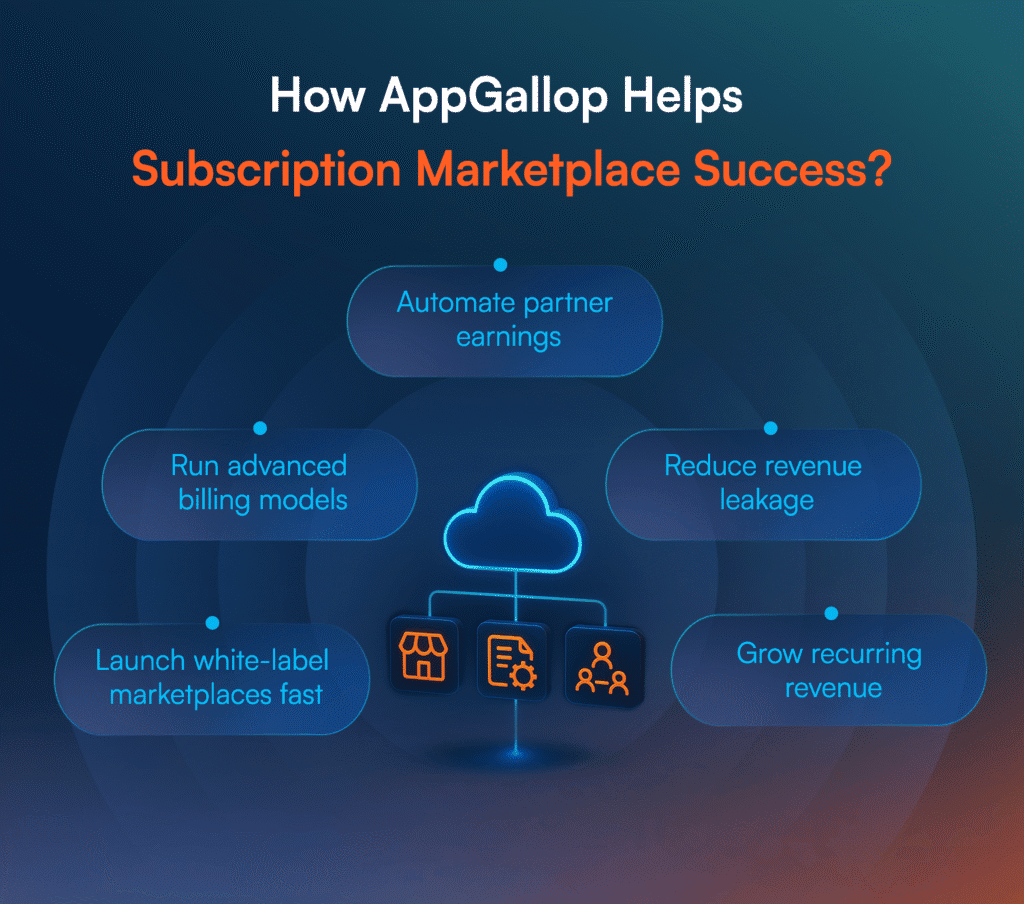
AppGallop provides subscription marketplace infrastructure that helps you:
- Launch white-label marketplaces fast with multi-tenant storefronts for distributors, VARs, and MSPs.
- Run advanced billing models across recurring, usage-based billing, arrears billing, and true-up billing from one rating engine.
- Automate partner earnings through multi-tier distribution, partner commission automation, and dynamic credit management.
- Reduce revenue leakage with mediation systems, reconciliation automation, and full audit trail maintenance.
- Grow recurring revenue through renewal automation, co-term alignment, and trial-to-paid subscription commerce flows.
Cloud distributors and telcos using AppGallop have seen faster marketplace rollout, fewer manual billing corrections, and better partner adoption, as they move from disconnected tools to a single subscription marketplace platform.
Practical Steps To Launch Your Subscription Marketplace
You do not need to redesign your entire business to start. A step-by-step plan keeps risk low while proving value early.
1. Start with one segment and catalog. Pick a clear slice of your business: Microsoft CSP offers, a security stack, or a group of SaaS products. Design how these items show up inside your subscription marketplace model, including bundles and upgrade paths.
2. Map quote-to-cash and lead-to-cash flows. Decide how quotes, approvals, provisioning, billing, and collections will move through the subscription marketplace platform. Include tax, payment gateway integration, and GL integration from the start.
3. Onboard a small partner group. Invite a group of MSPs or VARs, share training through channel partner enablement programs, and test their full flow from marketplace subscription to commission payout. Use partner performance scorecards to capture feedback.
4. Add finance controls. Configure dunning campaign management, UTR recon generation (where needed), VAT and GST management, and revenue leakage detection reports so finance trusts the numbers.5. Scale across services and regions. Once the first wave works, extend to more vendors, regions, and business models, such as hybrid pricing models, reserved capacity pricing or IoT device billing. Treat this as an ongoing subscription marketplace business program, not a one-time IT project.
Frequently Asked Questions
A subscription marketplace is a digital platform where many providers sell products or services on a recurring basis in one place. Customers use a single portal to buy, renew, and change subscriptions, while the operator handles billing and access.
A subscription marketplace focuses on ongoing relationships rather than one-time orders. It manages renewals, upgrades, downgrades, proration, and recurring billing rules so plans and invoices stay accurate over time.
CSPs, MSPs, telcos, ISVs, and distributors selling many recurring services benefit the most. Customers get one place for all subscriptions, partners get clear pricing and payouts, and finance teams see cleaner recurring revenue and churn data.
A subscription marketplace earns through margin on resold services, vendor listing or program fees, and commissions on each transaction. Some operators also charge for premium placement, marketing help, or analytics add-ons while vendors gain extra reach.
Conclusion
To wrap up, subscription marketplaces are quickly becoming the base layer for B2B subscription commerce. Buyers expect one place to manage all their subscriptions, finance teams want clear revenue recognition and audit trails, and partners need a fair, transparent way to sell recurring services.
A strong subscription marketplace platform brings catalog, billing, partners and analytics together so you can grow recurring revenue without drowning in manual work. AppGallop gives CSPs, MSPs, telcos and ISVs a ready platform to launch white-label subscription marketplaces, support complex billing, and build solid partner ecosystems. If you are planning your next phase of growth, this is the right time to turn your subscription catalog into a scalable marketplace.