



Telecom margins are under pressure while pricing models get more complex every quarter. Voice, data, IoT, UCaaS, and cloud services all run on different plans, discounts and contracts. Yet many providers still rely on legacy telecom billing software or custom scripts that were never built for usage-based products at this scale.
The opportunity is huge. The global telecom services market is projected to reach 2,874.8 billion US dollars by 2030 (Grand View Research), so even a small percentage of revenue leakage or billing delay has a major impact on profit.
Before we go further, ask yourself:
- Are you still reconciling call detail records and usage files in spreadsheets every month?
- Do pricing changes take weeks to show up in your telecom billing system?
- Are finance teams spending entire cycles chasing disputes and missed payments rather than analysing growth?
If you lead a telco, CSP, MVNO, MSP, or cloud distributor, modern telecom billing software is no longer just a back-office tool. It is the engine that supports convergent billing, revenue assurance, and partner payouts across your full product stack.
This guide explains how modern platforms work, why legacy billing creates hidden costs, and how solutions like AppGallop support advanced billing and revenue operations for telecom and cloud providers.
Key Takeaways
- Telecom billing software handles usage collection, rating, invoicing, and revenue recognition across voice, data, IoT, and cloud services.
- Legacy telecom billing systems cause revenue leakage, slow product launches, and compliance risk as pricing models expand.
- Modern platforms combine usage-based billing, convergent billing, revenue assurance, and integration with BSS or OSS and finance tools.
- Decision makers should look for event-driven billing engines, mediation systems, multi-currency billing, and strong dunning management.
- AppGallop offers telecom billing solutions built for convergent offerings, partner ecosystems, and cloud marketplace operations.
What Is Telecom Billing Software?
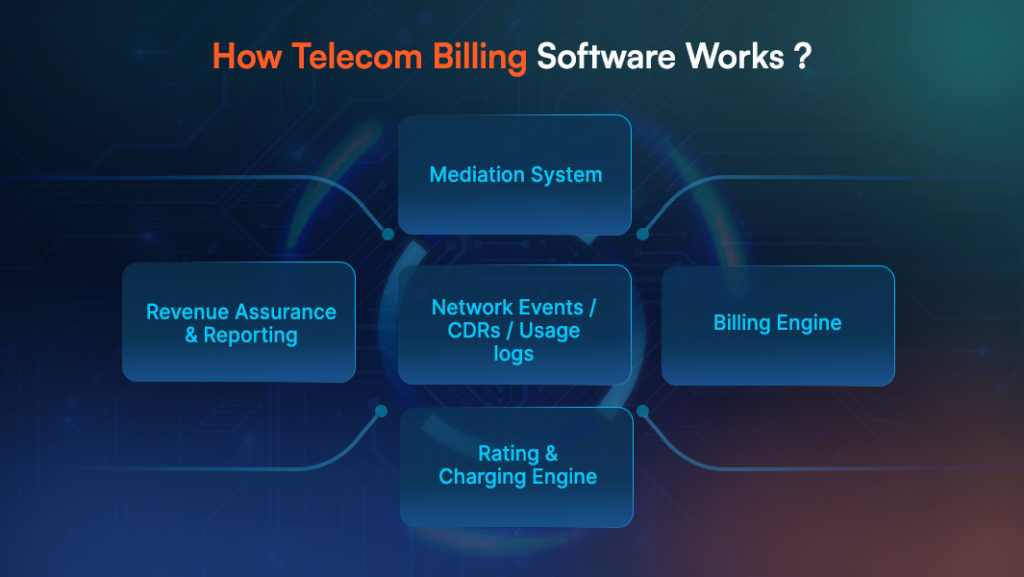
Telecom billing software is a specialised billing and revenue management platform used by telecom operators, CSPs, MVNOs, MSPs, and ISVs to rate usage, create invoices, and recognise revenue for telecommunications and cloud services. A modern telecom billing system handles recurring subscriptions, usage records, and one-time fees in a single place.
At its core, telecom billing software includes:
| Component | What It Does In Telecom Billing |
| Mediation system | Collects call detail records, data usage logs, and event files, then normalises them for billing. |
| Rating and charging engine | Applies tariffs, discounts, tiered pricing models, and consumption-based pricing rules to each event. |
| Billing engine | Creates invoices using usage-based billing, arrears billing, advance billing, or mixed models. |
| Revenue assurance and reporting | Checks for missing events, duplicates, and rating issues, and provides telecom revenue management dashboards. |
| Integration layer | Connects billing with CRM, ERP, BSS or OSS, payment gateways, and tax systems. |
Unlike generic subscription tools, telecom billing software is built for high-volume metered billing and complex product structures such as bundles of mobile, data, UCaaS, CCaaS, and IoT services.
Why Legacy Telecom Billing Systems Hurt Revenue?
Telecom operators and CSPs are moving from simple voice plans to convergent offerings that combine telecom, SaaS, and infrastructure. The telecom billing and revenue management market itself is forecast to reach 38.5 billion US dollars by 2033 (MarketIntelo), which shows how much investment is flowing into this area. Yet many providers still run billing on custom legacy stacks.
Revenue Leakage From Incomplete Or Delayed Charging
Industry analysis suggests telecom revenue leakage can range from 1% to 5% of total annual revenues (BillRun). When global operators already lose around 30 billion US dollars in uncollected revenue (Infosys BPM), gaps in telecom billing software directly hit cash flow.
Legacy mediation systems that rely on nightly batch jobs make it hard to spot anomalies quickly. Without event-driven billing and a strong billing mediation layer, providers either overcharge and increase disputes or undercharge and lose revenue.
Slow Time To Market For New Services
Fifth-generation networks, IoT, and cloud services need flexible pricing models such as metered billing, mixed pricing models, and pay-as-you-grow plans. When each new product needs hard-coded changes inside an old telecom billing system, launch cycles move from days to months.
Modern platforms use catalog-driven billing and configuration for usage rules, making it simple to support new devices, UCaaS billing, CCaaS monetization, or IoT device billing without major code changes.
Rising Compliance And Audit Pressure
With ASC 606 and IFRS 15 in play, finance leaders need accurate revenue recognition automation and clear audit trails. Legacy billing stacks often rely on manual spreadsheets to calculate deferred revenue schedules and revenue waterfall reports.
Modern telecom billing software pushes structured data straight into general ledger systems, supports multi-entity accounting, and records every subscription lifecycle event for audit-ready telecom revenue management.
Core Capabilities Of Modern Telecom Billing Software
A modern telecom billing solution does more than create invoices. It supports full quote to cash and leads to cash flows across telecom and cloud services.
Usage Collection, Rating, And Event-Driven Billing
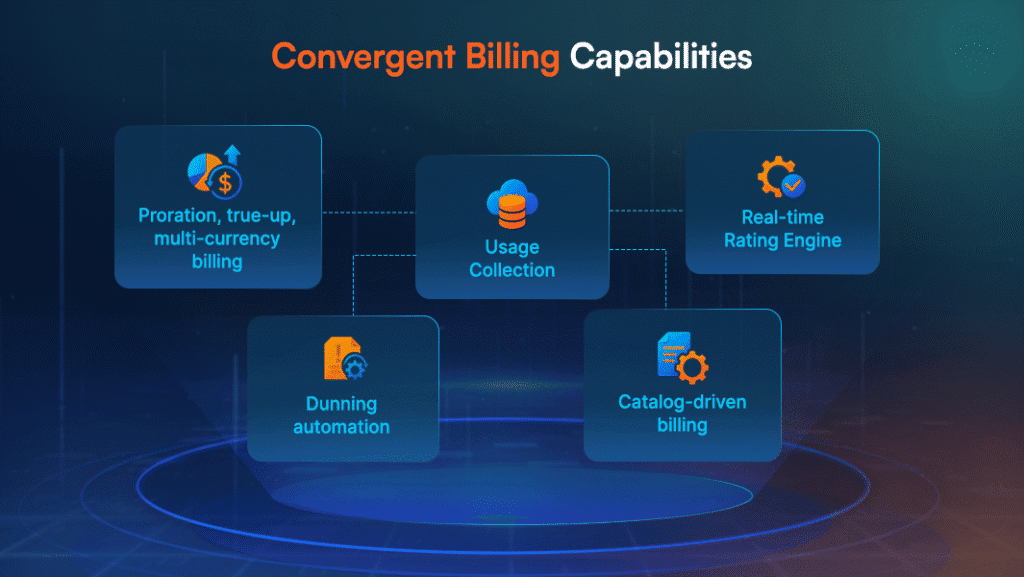
Usage analytics and tracking collect call detail records, data sessions, and API events from network systems, IoT platforms, and SaaS services. Event-driven billing with a real-time rating engine allows you to price services the moment they occur, which is important for roaming billing, content delivery billing, and subscription add-ons.
Flexible Pricing And Convergent Billing
Telecom providers now mix subscription, usage, and one-time charges in a single offer. A strong telecom billing system supports:
- Convergent billing across voice, data, messages, UCaaS, CCaaS, and cloud services.
- Tiered pricing models for high-volume customers.
- Proration billing and prorated charges for mid-cycle upgrades or downgrades.
- True up billing when actual usage exceeds committed use discounts.
- Billing hierarchy management for parent-child accounts, corporate structures, and reseller models.
This flexibility lets you design packages that match customer usage without building one-off workarounds.
Invoicing, Taxation, And Collections
On the finance side, telecom billing software needs to support many modes: arrears billing, advance billing, milestone-based billing, and spot billing for one-off jobs. Key features include:
- Multi-currency billing and VAT or GST handling for global customer bases.
- Sales tax automation for different jurisdictions.
- Bill consolidation that combines many services into a single statement of account.
- Dunning campaign management and collections workflow automation to handle failed payments.
This has a direct impact on working capital. A large share of telecom cash flow issues comes from delays in billing and collection rather than pure demand problems.
Revenue Assurance, Analytics, And IoT Growth
The number of connected IoT devices is expected to reach 19.1 billion in 2024 (IoT Analytics), which adds huge volumes of small events to telecom billing workloads. Usage analytics and revenue leakage detection help teams catch misrated services early.
Modern platforms provide telecom-specific dashboards for ARPU, churn prediction models, negative churn, and expansion revenue tracking. This moves billing from a back-office function to a source of insight for pricing and product teams.
Integration And Architecture Foundations
To handle this scale, modern telecom billing solutions often follow an API first approach and microservices-based design. They expose clean APIs and webhook notifications so they can connect with:
- CRM tools for order capture and quote journeys.
- BSS and OSS for provisioning, SIM lifecycle management, and service orchestration.
- Payment gateway integration and collections systems.
- Data lake integration for downstream analytics and AI models.
This integration layer is what lets providers bring together traditional telecom billing with cloud marketplace operations and partner ecosystems.
How Different Providers Use Telecom Billing Software
Telecom billing is no longer limited to traditional mobile operators. Here is how different players use similar capabilities.
| Provider Type | Typical Use Cases | Specific Billing Needs |
| Telcos and communication service providers | Retail billing for consumer and enterprise plans, wholesale billing for interconnect settlement | Convergent billing, interconnect billing, roaming billing, tariff plan management, telecom fraud management |
| MVNOs and MVNEs | Resell network capacity under their own brand | MVNO billing with multi-tenant SaaS support, billing hierarchy management for partners |
| Cloud distributors and aggregators | Resell infrastructure, platforms and software along with connectivity | Mixed pricing models, cloud marketplace operations, usage usage-based billing across many vendors |
| MSPs and ISVs | Offer managed services, cybersecurity, UCaaS and CCaaS | Subscription lifecycle events, backup as a service billing, SaaS metrics tracking such as monthly and annual recurring revenue |
| Enterprise service providers | Provide private networks, IoT connectivity and colocation billing | IoT device billing, reserved capacity pricing, multi-entity accounting |
This is the mix of customers AppGallop focuses on: telcos, CSPs, MSPs, ISVs and distributors who need advanced billing and revenue operations across telecom and cloud services.
How To Choose A Telecom Billing System?
Once you understand what telecom billing software should cover, the next step is selection. Comparison searches often focus on feature checklists, but decision makers care about risk, revenue impact, and long-term flexibility.
Start From Revenue Flows, Not Just Features
Begin by mapping your quote to cash and lead to cash flows:
- How do leads move into quotes and orders?
- When provisioning and activation events occur?
- How does billing handle subscription lifecycle events such as upgrades, downgrades, or disconnects?
Your chosen telecom billing solution should support these flows without heavy custom code. Look for support for service orchestration where bundles must break into separate provisioning jobs.
Evaluate Pricing And Catalog Flexibility
Ask vendors to show how they handle new offers similar to your roadmap.
- Can they model mixed pricing models that combine fixed fees with usage charges?
- Can non-technical users update tariff plan management, discounts, and partner-specific pricing?
For CSPs and cloud aggregators, catalog flexibility must cover both telecom products and cloud marketplace items.
The same billing platform should handle data plans, software licences, devices, and bundled offerings.
Check Revenue, Finance, And Compliance Coverage
Finance teams need more than basic invoicing. When you evaluate telecom billing systems, check:
- Support for ASC 606 and IFRS 15.
- Revenue recognition automation and deferred revenue scheduling.
- Audit trail maintenance for every charge and adjustment.
- General ledger integration and multi-entity accounting if you operate across regions or legal entities.
These controls give finance leaders confidence to scale while keeping regulators satisfied.
Look At the Integration Path And the Delivery Model
Finally, examine how the solution fits into your current stack.
- Does it offer API first architecture and single sign-on with role-based access control?
- Does it support integration platforms for CRM and ERP tools you already use?
Time to value matters here. Some modern telecom billing platforms offer ready connectors for common BSS, OSS, and cloud platforms, which shortens implementation from many months to weeks.
How AppGallop Powers Telecom Billing Software For Modern Providers
AppGallop is a cloud commerce and billing platform built for telcos, CSPs, and distributors that need accurate, flexible billing across telecom and cloud services. It connects marketplace infrastructure, partner management, and advanced billing in one place.
AppGallop provides telecom-focused billing and revenue automation that supports:
- Usage-based billing and metered charging across voice, data, software, and IoT.
- Multiple billing cycles, including arrears billing, advance billing, milestone-based billing, and spot billing.
- Proration billing and co-term alignment so mid-cycle changes stay fair for both customer and provider.
- Multi-currency billing and tax handling with VAT or GST rules for different regions.
- Revenue recognition automation aligned with ASC 606, plus deferred revenue scheduling and clear audit trails.
- Dunning management and payment retry logic through integrated payment gateways.
- BSS or OSS integration and API first design so orders flow smoothly from CRM to provisioning to billing.
Telecom and cloud providers using AppGallop aim for near-perfect billing accuracy and move from day-long invoice runs to near-real-time cycles, which helps reduce disputes and raise cash flow reliability. This gives commercial teams confidence to introduce new bundles and pricing models without adding manual workload for finance and operations.
Conclusion
Telecom billing software has moved from a simple invoice engine to the core system of record for convergent telecom and cloud revenue. As services expand across IoT, software, UCaaS and infrastructure, legacy telecom billing systems struggle to keep up with usage-based billing, revenue assurance, and partner payouts.
Modern telecom billing solutions bring together mediation systems, rating engines, tax handling, and dunning management, plus deep integration with BSS, OSS, and finance tools.
Platforms like AppGallop add marketplace and partner layers on top, so telcos and CSPs can grow through both direct and indirect channels without losing control of revenue.
If your teams are still reconciling usage files by hand or managing revenue recognition in spreadsheets, this is the moment to look at a modern telecom billing system that can support your next few years of product growth.
FAQs
Telecom billing software is a specialised system that collects usage data such as call detail records, rates that usage according to tariffs and plans, and generates invoices for telecom and cloud services. It also handles discounts, taxes, adjustments and revenue recognition so telcos and CSPs can charge accurately for voice, data, IoT and value added services.
A telecom billing system works by pulling raw usage data from network elements and platforms into a mediation layer, normalising it and feeding it into a rating engine. The rated events then move into a billing engine that applies billing cycles, taxes and discounts, creates invoices and pushes financial entries into accounting and general ledger systems. Dunning workflows handle failed payments and collections.
Telecom billing software should include mediation systems for event data, rating and charging engines, flexible product and pricing catalogues, support for usage based billing and convergent billing, multi currency billing and tax calculation, and revenue recognition automation. Strong integrations with CRM, BSS or OSS and payment gateways are also important, along with analytics for revenue assurance and churn monitoring.
Telecom billing software is designed for high volume event data, complex tariff structures and telecom concepts such as roaming, interconnect billing and wholesale billing. Generic subscription billing tools usually focus on simple recurring charges and limited usage tiers, which makes them hard to adapt to telecom revenue management, IoT device billing or carrier grade partner ecosystems.