




Telecom teams are being asked to grow while keeping activation timelines tight and customer experience clean. The catch is that demand can rise even when unit economics do not. PwC highlights this tension clearly in the US mobile market: subscribers are projected to grow at a 4.9% CAGR while ARPU falls at –1.5% CAGR.
That is why a telecom order management system is now a core operations platform, not just a workflow tool. It is the system that coordinates the end-to-end lifecycle of a service request, from order capture through fulfillment, activation, and billing, while keeping every team aligned on a single order state.
Key takeaways
- A telecom OMS turns complex orders into clear, trackable steps across teams and systems.
- Quote-to-activation improves when dependencies are orchestrated, not chased manually.
- Order fallout is usually caused by data gaps and handoffs, not customer behavior.
- Real-time status visibility reduces escalations because everyone sees the same truth.
- Automation works best when catalog rules and integrations are standardized.
- Exception handling must be designed as a workflow, not a shared inbox.
What is A Telecom Order Management System?
Telecom order management is the end-to-end process that executes a customer service request across multiple teams and systems. A telecom order management system (OMS) is the platform layer that runs this process: it captures orders, validates them, breaks them into executable steps, orchestrates work across BSS/OSS, tracks progress, and manages exceptions.
It is not a replacement for CRM, billing, inventory, or provisioning. It is the coordinator who keeps these systems in sync as the order moves from “requested” to “delivered.”
Why Telecom Order Management Breaks at Scale?
Most CSPs do not struggle because they cannot “process orders.” They struggle because modern telecom orders are:
- multi-channel (web, partners, assisted sales)
- multi-product (bundles, add-ons, upgrades)
- multi-system (CRM, catalog, billing, network, logistics)
- high-stakes (activation delays trigger churn risk and escalations)
When order complexity rises, manual coordination starts to look like a process. In reality, it becomes a bottleneck.
This is why telecom OMS platforms are increasingly positioned around simplifying quote-to-activation and reducing fallout created by process complexity.
The Telecom Order Lifecycle, End-to-End
Before we get into features, it helps to anchor the conversation on the lifecycle. This is where teams usually discover hidden handoffs and invisible failure points.
Below is a practical lifecycle view you can use to map your current state and target state.
| Stage | What happens | Where it typically breaks | What a telecom OMS should do |
| Order capture | Order enters from digital, assisted, or partner channels | missing data, wrong offer selection | normalize inputs, enforce guided capture |
| Validation | Feasibility, eligibility, and policy checks | mismatched address, eligibility errors | run pre-check rules before orchestration |
| Decomposition | Split bundle into service and resource steps | bundle logic gaps | create traceable sub-orders with dependencies |
| Orchestration | Coordinate tasks across teams and systems | wrong sequencing, blocked dependencies | manage dependencies and trigger downstream systems |
| Fulfillment | Device shipment, install scheduling, service readiness | missed milestones, handoff delays | track milestones and enforce next-step triggers |
| Provisioning and activation | Configure services and confirm activation | provisioning errors, partial completion | monitor responses, retry and escalate intelligently |
| Billing readiness | Ensure billing triggers match activation state | billing mismatch, delayed charging | confirm state, push clean activation signals |
| Change and cancel flows | Moves, adds, changes, disconnects | inconsistent status across systems | maintain state transitions and audit trails |
The goal is simple: fewer manual touchpoints per order, with faster detection when something goes off track.
Key Functions and Features of a Telecom OMS
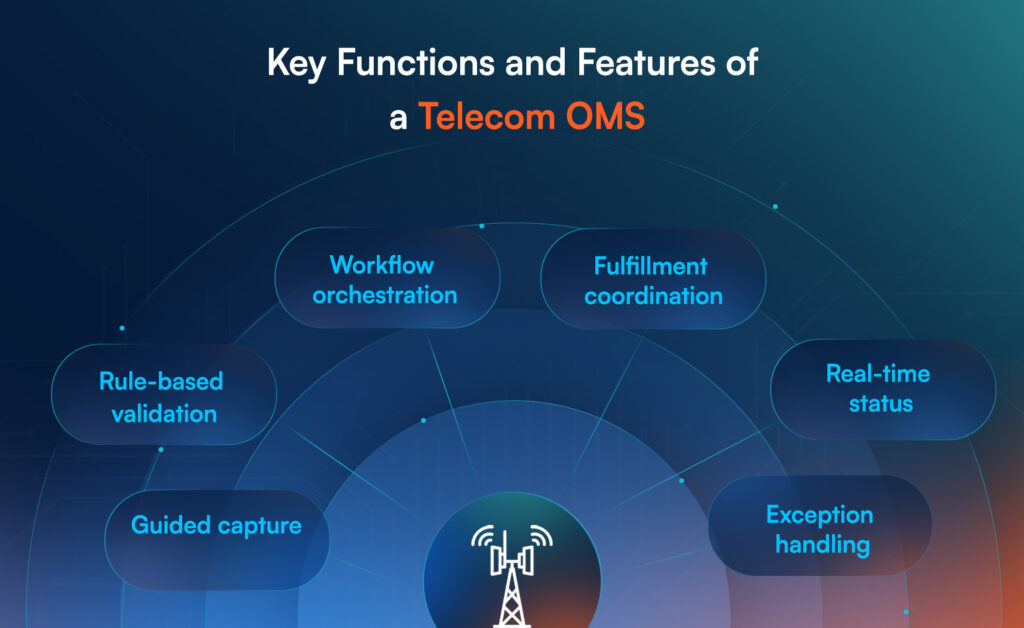
A modern telecom OMS should make the order predictable, even when the product and delivery path are not. The most important capabilities usually map to what telecom teams see in daily operations.
- Order capture and validation
Validation is where you prevent downstream chaos. The OMS should support rule-driven checks for completeness, feasibility, and eligibility so bad orders are stopped early instead of becoming fallout later.
- Workflow automation and orchestration
Orchestration is the heart of telecom OMS. It coordinates the quote-to-activation sequence across systems and teams, while reducing complexity and minimizing order fallout.
- Service fulfillment coordination
Telecom fulfillment is a mix of digital activation and physical work. Your OMS needs to coordinate devices, appointments, service readiness, and activation milestones without relying on manual follow-ups.
- Real-time visibility into order status
Visibility is not a dashboard preference. It is the difference between proactive resolution and reactive escalation. A telecom OMS should provide consistent order state updates so support, operations, and customers are not working from different versions of reality.
- Integration across BSS and OSS
OMS value is directly tied to integration quality. The objective is not “more integrations.” The objective is cleaner data flow, reliable state updates, and fewer brittle handoffs across CRM, catalog, billing, inventory, and network systems.
- Exception handling and order fallout management
Order fallout is not rare in telecom. TM Forum notes some sources claim fallout rates can be as high as 15% to 25%, and that providers often lack visibility to quickly fix root causes.
A strong telecom OMS treats exceptions as a first-class workflow with ownership, routing logic, retries, and structured resolution.
What “Good” looks like in Telecom OMS Operations
If you want to pressure-test your current OMS setup, look at these outcomes, not feature checklists.
- Orders move forward without people asking, “who owns this next?”
- Fallout is detected early, categorized clearly, and routed to the right resolver
- Customers and support see consistent status, not conflicting updates
- Activation signals and billing readiness stay aligned
- Teams can identify repeating failure patterns and remove root causes
This is the operational maturity most telecom OMS modernization programs aim for.
Where AI Helps in Telecom Order Management
AI becomes valuable when it reduces exception load and improves speed of resolution. The best uses are practical.
- Predict which orders are likely to fail based on historical patterns
- Route exceptions faster by classifying the failure type
- Detect mismatches between provisioning responses and billing readiness signals
A concrete example comes from a TM Forum Airtel and Amdocs case study, which reports a 60% reduction in call center volumes within six months and order fallout decreased by 90% after introducing AI-driven automated operations.
The important point is not the tooling. It is the combination of connected workflows plus reliable order state data.
A List of Problems that Slow Telecom Orders and How AppGallop Solves Them
Telecom order programs often break down in the same few places. Especially when CSPs, MSPs, or telco-led marketplaces have to fulfill multi-vendor cloud services alongside core connectivity.
Here is a structured view of where pain shows up, what it causes, and how AppGallop supports the resolution.
| Order pain point | What it looks like in reality | How AppGallop Helps |
| Activation depends on manual handoffs | Teams chase status across systems, and delays become normal | automates fulfillment steps so execution does not depend on follow-ups |
| Inconsistent provisioning across vendors | Each product has a different “activation reality.” | standardizes provisioning flows across cloud products and marketplaces |
| Low visibility during fulfillment | Support cannot confidently answer “what is the status?” | provides clearer execution tracking across the fulfillment layer |
| Exceptions pile up without clear resolution paths | Tickets bounce between teams | supports repeatable workflows that reduce ad hoc exception handling |
| Scaling adds complexity, not capacity | Volume rises, but delivery quality drops | reduces manual work so teams can handle growth without chaos |
What changes operationally when this works?
Teams stop relying on spreadsheets and internal chasing to move orders forward. Fulfillment becomes a managed workflow with fewer failure points and faster resolution when something breaks.
Cut activation delays caused by handoffs and exceptions. Get a free demo today!
KPIs that Show OMS Impact
To keep OMS work tied to business outcomes, measure what changes in daily execution.
| KPI | What does it tell you |
| Order cycle time | Speed from request to activation |
| Fallout rate | How often do orders require exception handling |
| First-time-right activation | Activation without rework or manual intervention |
| Time to resolve exceptions | How quickly is fallout cleared |
| Billing readiness accuracy | Whether activation and billing stay aligned |
| Contact rate during provisioning | Whether customers and support need to chase the status |
These metrics help you move from “we implemented an OMS” to “orders are predictably delivered.”
Conclusion
A telecom order management system is the platform that turns demand into delivered services, without your teams becoming the glue between disconnected systems. When done well, it shortens quote-to-activation, improves visibility across the lifecycle, reduces fallout, and keeps billing aligned with real activation states.
It also creates the foundation for automation and AI, because connected workflows produce clean signals and repeatable resolution paths. If your current order operations rely on manual coordination, inconsistent statuses, or reactive exception queues, the fastest starting point is to map your lifecycle, standardize order states, and modernize orchestration with strong BSS/OSS integration.
FAQs
A telecom OMS is a system that manages service orders end-to-end by coordinating capture, validation, orchestration, fulfillment, activation, and exception handling across multiple teams and integrated systems.
Order management covers the full lifecycle. Orchestration is the execution layer that sequences and coordinates steps across systems and teams to reach activation.
Common causes include incomplete data at capture, catalog rule mismatches, integration failures during provisioning, and unclear ownership of exceptions. TM Forum notes fallout can be significant and visibility is often poor.
It reduces fallout by validating earlier, orchestrating dependencies instead of relying on manual handoffs, and managing exceptions as structured workflows with routing and resolution paths.
It sits between them. OMS connects BSS systems like CRM and billing with OSS systems like provisioning and network operations to coordinate the order lifecycle.